As part of our Top 50 series, we break down how the best-performing Fantasy Premier League managers allocated their £100m budgets during the 2025/26 campaign.
By analysing spending patterns from the 2025/26 Top 50 and All-Time Top 50 groups, we can identify how much budget was typically invested in each position — and whether the season’s tactical shifts changed where elite managers spent their money.
The full range of Top 50 analysis can be found in the Preseason Pack, where users can also evaluate their own 2025/26 season and identify their strengths and weaknesses using the Skills Benchmark tool.
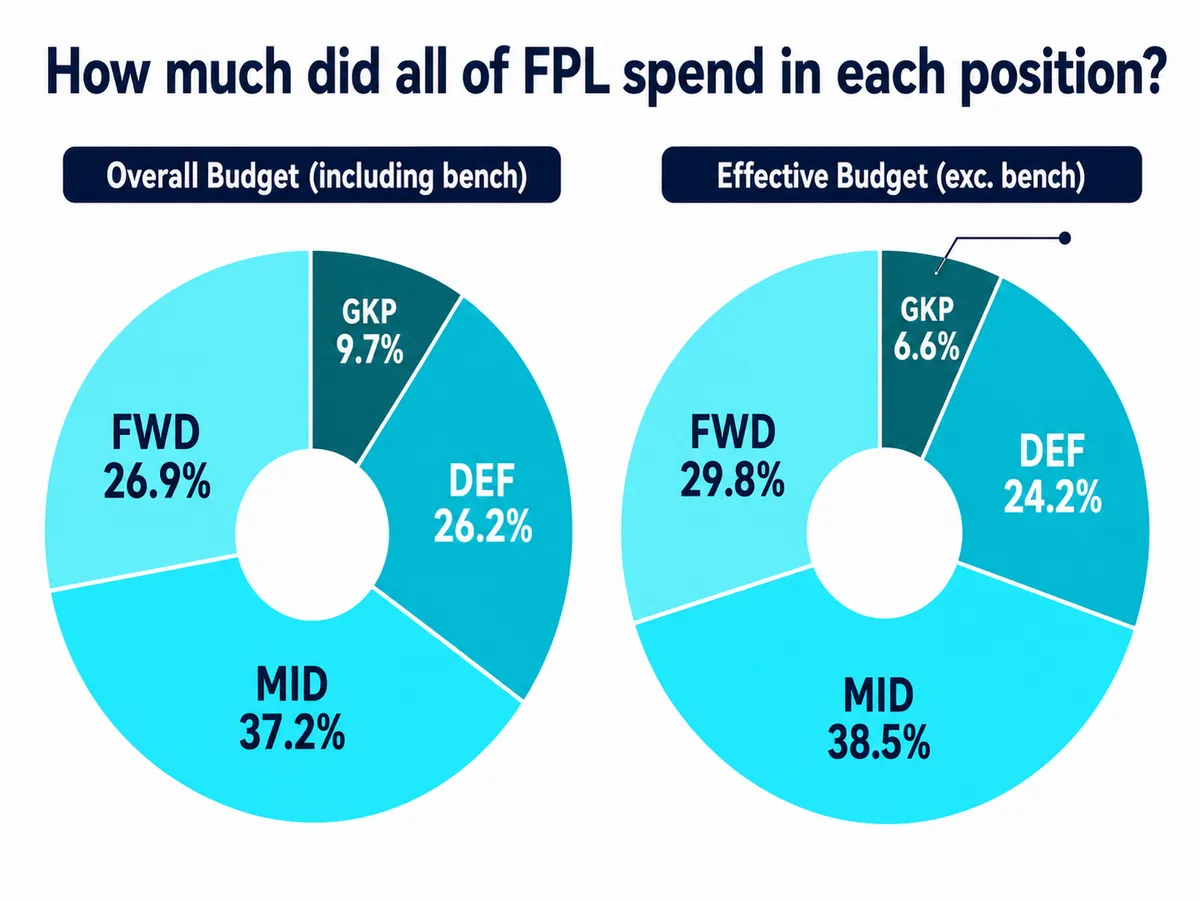
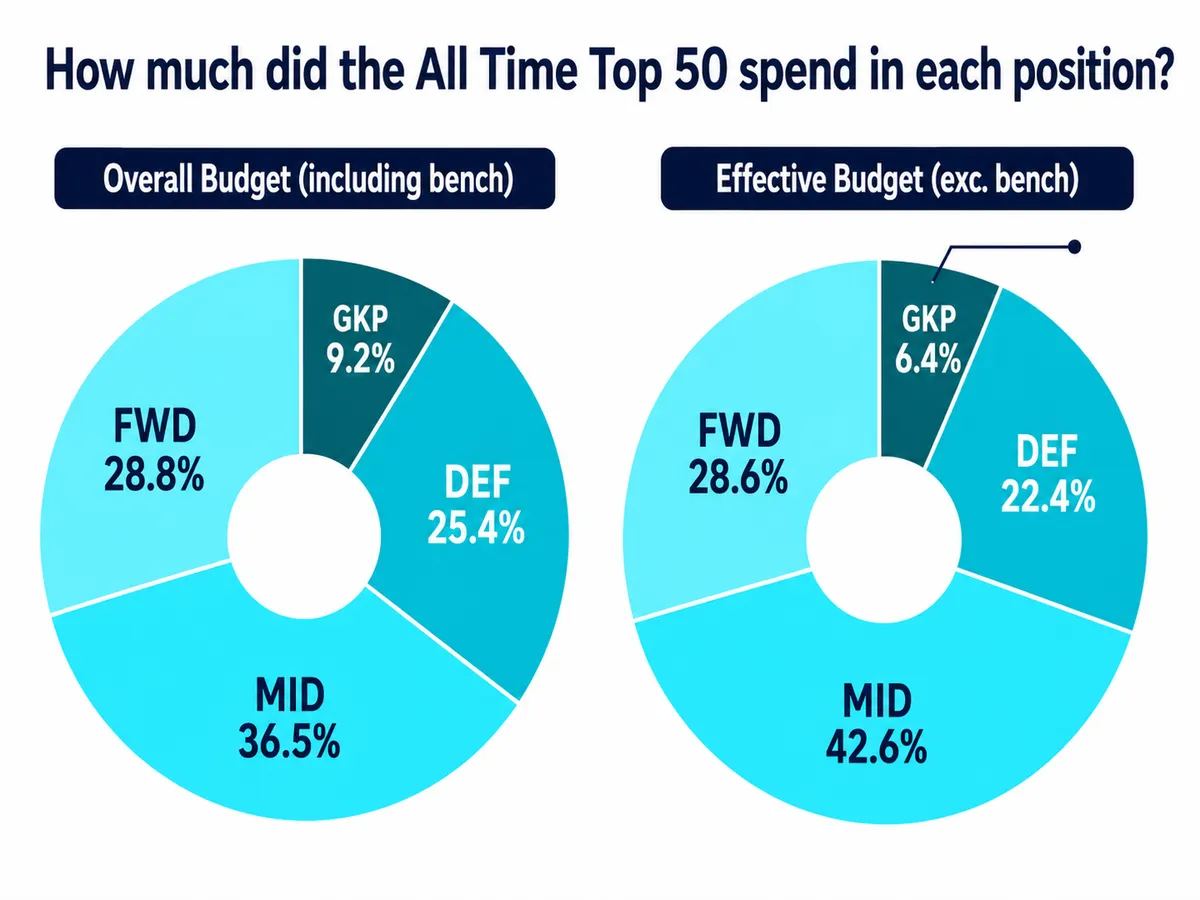
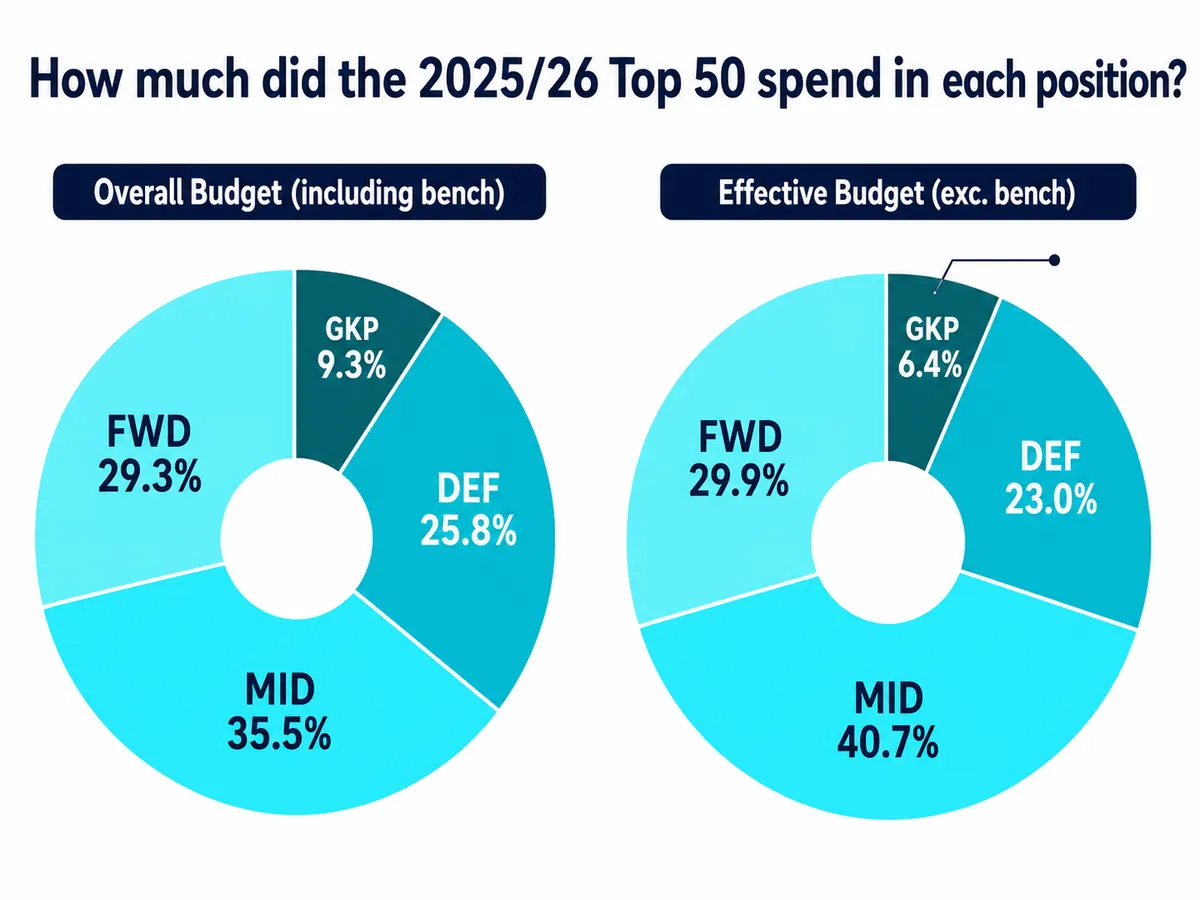
An interactive version of this graphic is available in the Preseason Pack.
The 2025/26 season created one of the more interesting budget landscapes in recent FPL history.
As covered in the Formation Trends section of this Top 50 Strategies, we saw an increase in managers using four-defender formations, particularly 4-4-2. Among the 2025/26 Top 50 managers, 4-4-2 was used 21.1% of the time, while the All-Time Top 50 used it 21.5% of the time.
That shift was likely influenced by the introduction of defensive contribution points, or DEFCON, which gave defenders more routes to points beyond clean sheets, goals and assists.
However, the budget data shows that this did not lead to a dramatic increase in defensive spending.
Instead, managers appeared to be more willing to start four defenders when the value was there, rather than simply spending big at the back.
Goalkeeper spend remained fairly stable, with a small increase compared to 2024/25.
The 2025/26 Top 50 managers allocated 9.3% of their total budget to goalkeepers, while the All-Time Top 50 allocated 9.2%. That is slightly up on last season, when the figures were 9.0% and 8.9% respectively.
In terms of effective budget — excluding bench spend — both groups allocated 6.4% to goalkeepers.
This slight rise was likely influenced by David Raya, who became a set-and-forget option for some FPL managers. Arsenal offered outstanding defensive security, keeping 19 clean sheets and conceding a league-low 27 goals, making Raya one of the safest routes into their backline.
Premium goalkeepers are not usually a popular route in FPL, but Raya proved an exception. His price rose as high as £6.2m, yet he still justified the investment by finishing as the top-scoring goalkeeper on 162 points — enough to rank 20th overall among all players.
Even so, the data suggests managers were still careful not to overcommit funds to the position. Goalkeepers can offer steady returns, particularly when attached to an elite defence, but they rarely become a major budget priority due to their lower ceiling compared with outfield players.
Raya’s season showed that a premium goalkeeper can work when the defensive platform is strong enough, but it is likely to remain more of an exception than the norm.
Defenders were the big talking point of 2025/26.
The introduction of DEFCON made the position more reliable, and the player points table showed just how influential defenders became. Gabriel finished on 209 points, making him the top-scoring defender of the season and the third-highest scoring player overall. Six defenders finished inside the top 20 overall FPL points scorers, including Gabriel, Marc Guéhi, Marcos Senesi, Virgil van Dijk, James Tarkowski and Nico O’Reilly.
Despite that, defensive spend only moved modestly.
The 2025/26 Top 50 managers allocated 25.8% of their total budget to defenders, while the All-Time Top 50 allocated 25.4%. When looking only at effective budget, defenders accounted for 23.0% of the Top 50 spend and 22.4% of the All-Time Top 50 spend.
That is important.
The rise in four-defender formations did not necessarily mean managers were returning to a “Big at the Back” strategy. Instead, the trend was more about selective defensive value.
DEFCON helped mid-priced defenders become more appealing. Managers could start a fourth defender without needing to load up on several premium picks. A £4.5m–£5.5m defender with strong defensive contributions, regular minutes and a decent fixture run could now compete more closely with midfielders and forwards in a similar price bracket.
Midfielders continued to receive the largest share of budget, but their dominance dipped compared to previous seasons.
The 2025/26 Top 50 managers allocated 37.5% of their total budget to midfielders, while the All-Time Top 50 allocated 38.5%. When looking at effective budget, that rose to 40.7% for the Top 50 and 42.6% for the All-Time Top 50.
So midfield was still the biggest area of investment — but the gap was not as extreme as it has been in some previous seasons.
One reason for that was the reduced number of reliable premium midfield options. Mohamed Salah finished the season priced at £14.0m, Cole Palmer at £10.3m and Bukayo Saka at £10.0m, but all were difficult to rely on for large parts of the campaign due to form, injury or limited minutes.
That left Bruno Fernandes as the standout premium midfielder for many managers, especially towards the end of the season. Fernandes finished second overall for FPL points on 235, just four behind Erling Haaland, and also equalled the Premier League single-season assist record.
The result was a midfield structure that still carried plenty of budget, but often through one premium or semi-premium option alongside better-value picks, rather than multiple expensive midfielders being locked in.
Forward spending was one of the biggest changes from 2024/25.
Last season, forward investment fell despite 3-4-3 returning as a popular formation. That was partly because Erling Haaland had an underwhelming campaign by his standards, with injuries and form issues reducing his ownership late in the season.
In 2025/26, the picture changed again.
The 2025/26 Top 50 managers allocated 27.3% of their total budget to forwards, while the All-Time Top 50 allocated 26.9%. In terms of effective budget, forwards accounted for 29.9% of the Top 50 spend and 28.6% of the All-Time Top 50 spend.
That is a clear sign that forwards became a more important budget area again.
Haaland was the main reason. He finished as the top-scoring FPL player of the season on 239 points and ended the campaign priced at £14.7m. With several other premium players failing to offer the same combination of minutes, output and captaincy appeal, Haaland became one of the few expensive assets managers were consistently willing to fund.
This also helps explain why midfield spend did not rise further. Managers were not ignoring midfielders, but with Haaland taking up such a large portion of the budget, and with fewer premium midfielders proving reliable, funds were naturally spread differently.
Yes — but perhaps not in the obvious way.
The increase in four-defender formations did not produce a major shift towards heavy defensive spending. Instead, it showed that managers were more comfortable starting defenders when they offered value through DEFCON, clean sheets and occasional attacking threat.
The bigger budget impact came from the premium-player landscape.
With Salah, Palmer, Saka and Isak all struggling to justify heavy investment for much of the season, and with Haaland and Fernandes emerging as the two key premium options, managers had fewer expensive players they felt forced to own.
That created a more flexible budget structure:
The key lesson for 2026/27 is that formation and budget strategy should be treated separately.
Four at the back may remain viable if DEFCON rules stay the same, but that does not automatically mean managers should pour money into defence. The better approach may be to identify defenders who offer reliable routes to points at fair prices.
Likewise, premium attackers will need to justify their price tags. If several £10.0m+ players are reliable early in the season, budget could quickly shift back towards midfield and attack-heavy structures. But if only one or two premium players look essential, managers may again have more room to spread funds across the squad.
The 2025/26 season showed that the best FPL managers were not locked into one template. They adapted to where the value was — and that flexibility could be just as important heading into 2026/27.

Get ready for the 2026/27 season – the Preseason Pack is just £1 for a limited time.
Join 89% of our members who won their main mini-league last season.
TRY IT NOWAlready a Premium user? Login here
© fantasyfootballfix 2024 | Terms of Use | Privacy Policy | Contact Us