Our Top 50 series analyses the strategies used by the most successful FPL managers of the 2025/26 season, comparing them with managers who have consistently performed at an elite level over several campaigns.
In this article, we focus on team structure and budget allocation, examining how the 2025/26 Top 50 and All-Time Top 50 managers distributed their funds across their 15-man squads.
Using average player-cost data from Gameweek 1 and the season as a whole, we can identify the squad structures, price points and player profiles favoured by the best managers — and the lessons that can be applied heading into 2026/27.
The full range of Top 50 analysis can be found in the Preseason Pack, where users can also evaluate their own 2025/26 season and identify their strengths and weaknesses using the Skills Benchmark tool.
The graphs below show the average cost of each player in the squads of the 2025/26 Top 50 managers and the All-Time Top 50 managers.
They also include a separate Gameweek 1 view, allowing us to compare how managers started the season with how their squad structures evolved over time.
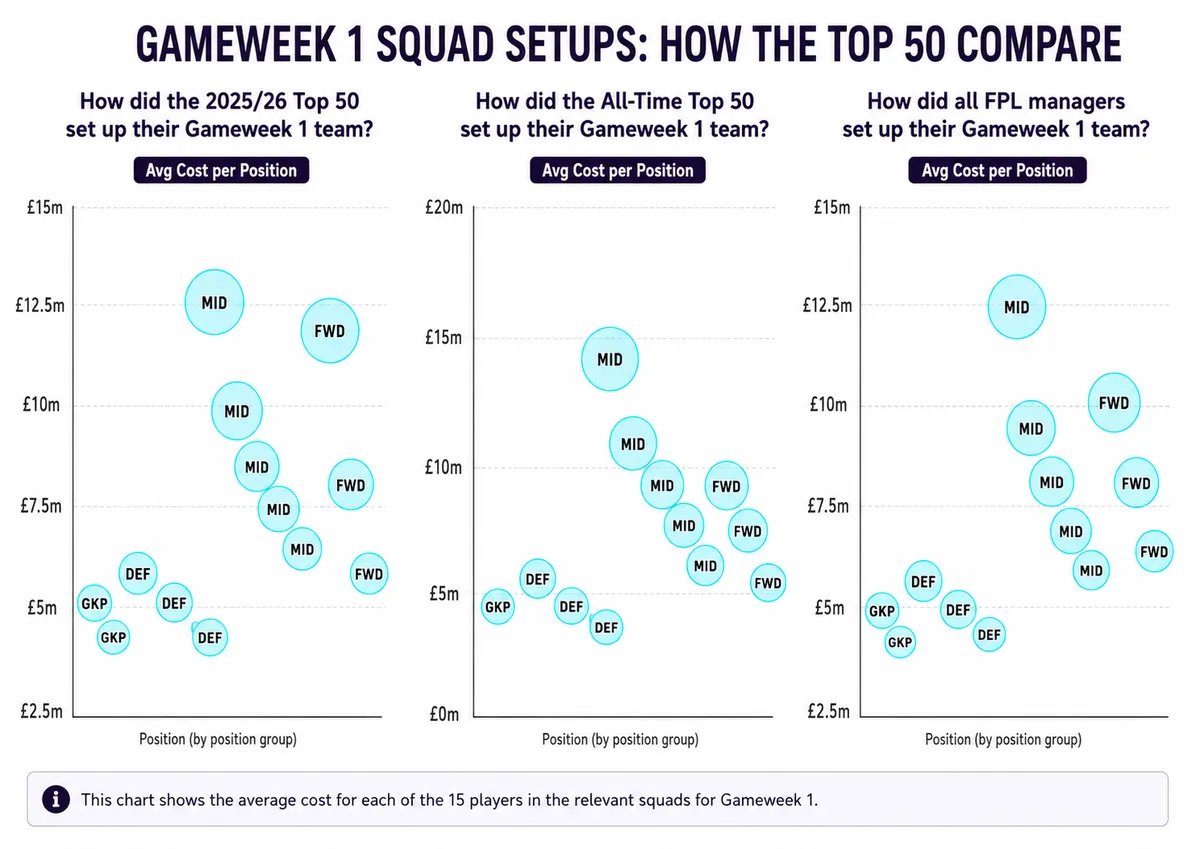
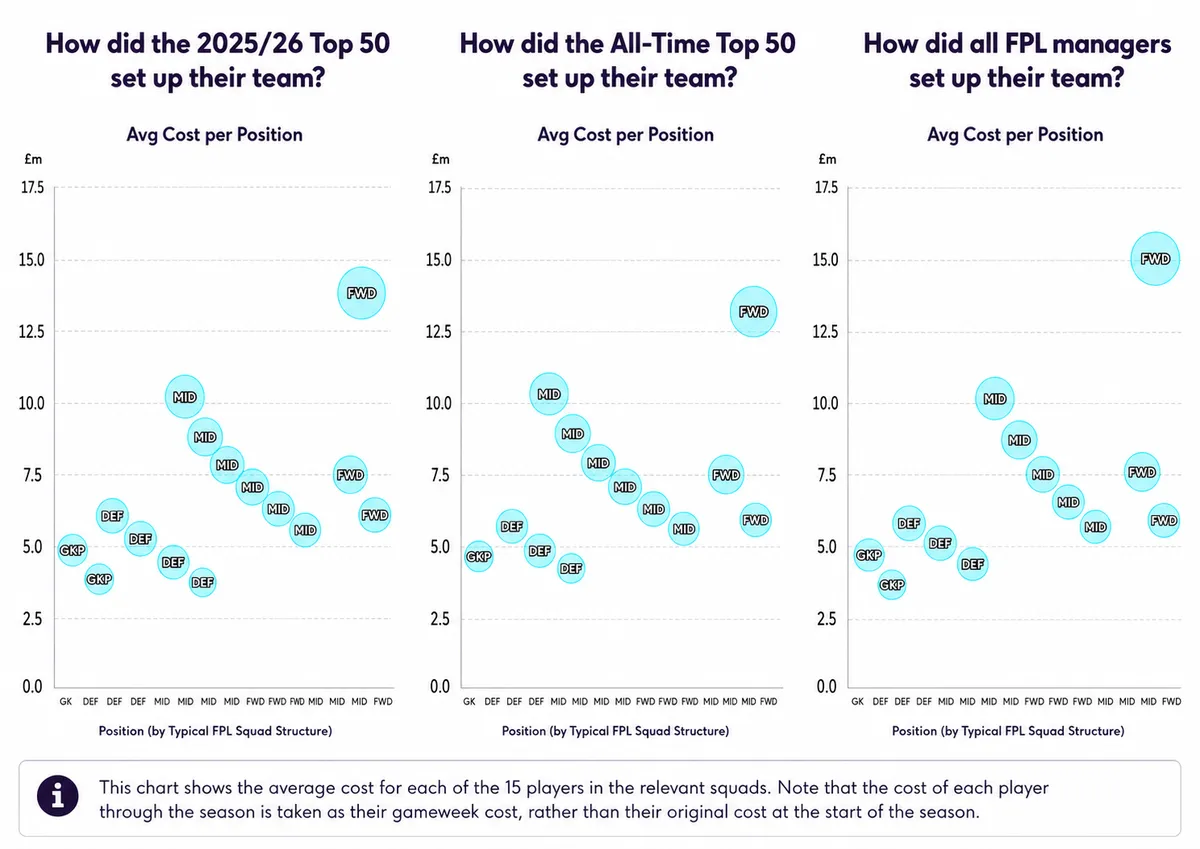
An interactive version of this graphic is available in the Preseason Pack.
The goalkeeper structure followed a familiar pattern, but with one important difference: David Raya became a genuine set-and-forget option.
In Gameweek 1, both the 2025/26 Top 50 and All-Time Top 50 managers kept things fairly simple in goal. The first goalkeeper slot averaged around £5.0m, while the second goalkeeper was close to £4.0m. That strongly suggests most managers preferred a reliable starter alongside a cheap bench option, rather than spending money on goalkeeper rotation.
Across the season, the first goalkeeper slot rose slightly to around £5.2m–£5.3m, which likely reflects Raya’s popularity as Arsenal’s defensive strength became impossible to ignore.
Arsenal kept 19 clean sheets and conceded just 27 goals, the fewest in the league. Raya’s price climbed as high as £6.2m, which is expensive by goalkeeper standards, but he justified the outlay by finishing as the top-scoring goalkeeper with 162 points — enough to rank 20th overall among all players.
Premium goalkeepers are not usually a popular FPL route because the position has a lower ceiling than defenders, midfielders and forwards. However, Raya showed that when a goalkeeper is attached to an elite defence, has strong clean-sheet potential and removes the need for rotation, the extra spend can be worthwhile.
Even so, the second goalkeeper slot remained cheap throughout the season. The top managers were willing to pay for one reliable goalkeeper, but not two.
That was made easier by the availability of several starting £4.0m goalkeepers during the campaign, such as Karl Darlow at Leeds and Martin Dúbravka at Burnley. With playing budget keepers available, managers could keep money on the bench to a minimum while still having cover if needed.
In short, Raya made the premium goalkeeper route viable, but the wider structure remained familiar: one trusted starter, one cheap backup, and as much money as possible saved for the outfield positions.
Defence was one of the most interesting areas of the 2025/26 season.
The introduction of defensive contribution points made defenders more attractive, and that was reflected in team structure. As covered in the formation data, four-defender setups became more common among top managers, with 4-4-2 and 4-3-3 both seeing notable usage.
However, the team setup charts show that managers were not simply loading up on expensive defenders.
The most expensive defender slot averaged around £6.4m–£6.5m across the season, while the second defender was closer to £5.5m. After that, the remaining defensive slots sat in the £4.0m–£5.0m range.
That suggests a balanced approach rather than a full return to “Big at the Back”.
Managers were often happy to carry one premium or near-premium defender, supported by several mid-priced or budget options who offered good value through minutes, clean sheets, DEFCON potential or attacking threat.
This makes sense when looking at the season’s top defensive scorers. Gabriel finished on 209 points, making him the highest-scoring defender of the season and the third-highest scoring player overall. He was joined inside the overall top 20 by Marc Guéhi, Marcos Senesi, Virgil van Dijk, James Tarkowski and Nico O’Reilly.
That level of defensive scoring made it easier to justify starting more defenders, but the best managers still avoided overcommitting too much budget to the position.
Midfield remained a major investment area, but the structure was different from some previous seasons.
In Gameweek 1, the All-Time Top 50 managers had a very expensive first midfield slot, averaging around £14.5m. That likely reflects heavy early investment in Mohamed Salah, who began the season as one of the standout premium midfield options.
The 2025/26 Top 50 managers were slightly less aggressive with their most expensive midfielder, with the first midfield slot closer to £12.0m in Gameweek 1. That suggests a broader mix of premium and semi-premium midfield strategies at the start of the campaign.
Across the season, the top midfield slot settled closer to £10.0m–£11.0m, with the second and third midfielders generally sitting in the £7.5m–£9.0m range.
This reflects one of the defining features of the 2025/26 season: several premium players struggled to justify their price tags.
Salah ended the season at £14.0m, while Cole Palmer finished at £10.3m and Bukayo Saka at £10.0m. But due to underwhelming form, injuries or limited minutes, none of them became reliable season-long holds for many managers.
That left Bruno Fernandes as the standout premium midfielder for much of the run-in. He ended the season priced at £10.4m and was one of the few expensive midfielders widely trusted by top managers late in the campaign.
So while midfield still attracted significant investment, it was not a season where managers simply stacked multiple premium midfielders. Instead, the best squads often combined one expensive midfielder with a stronger spread of mid-priced options.
The forward structure changed noticeably from the previous season.
In 2024/25, many managers started with Erling Haaland but moved away from him as the campaign progressed. In 2025/26, the opposite pattern emerged.
The Gameweek 1 charts show that the most expensive forward slot was not as extreme as the previous year, with the 2025/26 Top 50 averaging around £11.5m and the All-Time Top 50 closer to £9.0m. That suggests Haaland was not quite as universally locked in from the start as he had been in previous campaigns.
However, across the season, the first forward slot rose sharply to around £13.5m–£14.0m for both groups.
That points clearly towards Haaland becoming the key premium forward again. He ended the season priced at £14.7m and, along with Bruno Fernandes, was one of the few premium players that the majority of managers were willing to own towards the end of the season.
The rest of the forward line remained more modest. The second forward slot averaged around £8.0m, while the third forward was closer to £5.5m–£6.0m.
This suggests managers were not necessarily building fully forward-heavy squads. Instead, many used Haaland as the premium anchor, then filled the other forward slots with value picks depending on form, fixtures and availability.
The 2025/26 team setup data shows that the best FPL managers remained flexible.
They were willing to spend more in goal when Raya became a reliable route into Arsenal’s defence. They were more open to starting four defenders because of DEFCON, but without completely returning to a heavy defensive spend. Midfield remained important, but the lack of reliable premium options changed the way managers allocated funds. Up front, Haaland once again became the main premium player to build around.
The biggest lesson is that there was no single perfect structure.
Instead, the top managers adapted to where the value was:
Key Takeaways:
Heading into 2026/27, that flexibility could be crucial again. If DEFCON remains in place and defensive prices are kind, four-defender setups may stay viable. But if several premium attackers start strongly, managers may need to shift funds quickly back into midfield and attack.

Get ready for the 2026/27 season – the Preseason Pack is just £1 for a limited time.
Join 89% of our members who won their main mini-league last season.
TRY IT NOWAlready a Premium user? Login here
© fantasyfootballfix 2024 | Terms of Use | Privacy Policy | Contact Us