Our Top 50 FPL Managers series examines how the leading managers approached the 2025/26 season.
Here, we analyse how often the 2025/26 Top 50 and All-Time Top 50 retained the same players in each position from one Gameweek to the next, revealing whether they favoured a settled starting XI or regular fixture-based rotation.
You can also evaluate your own 2025/26 performance using the Skills Benchmark tool, available in the Pre-Season Pack, and compare your decision-making with some of the best FPL managers.
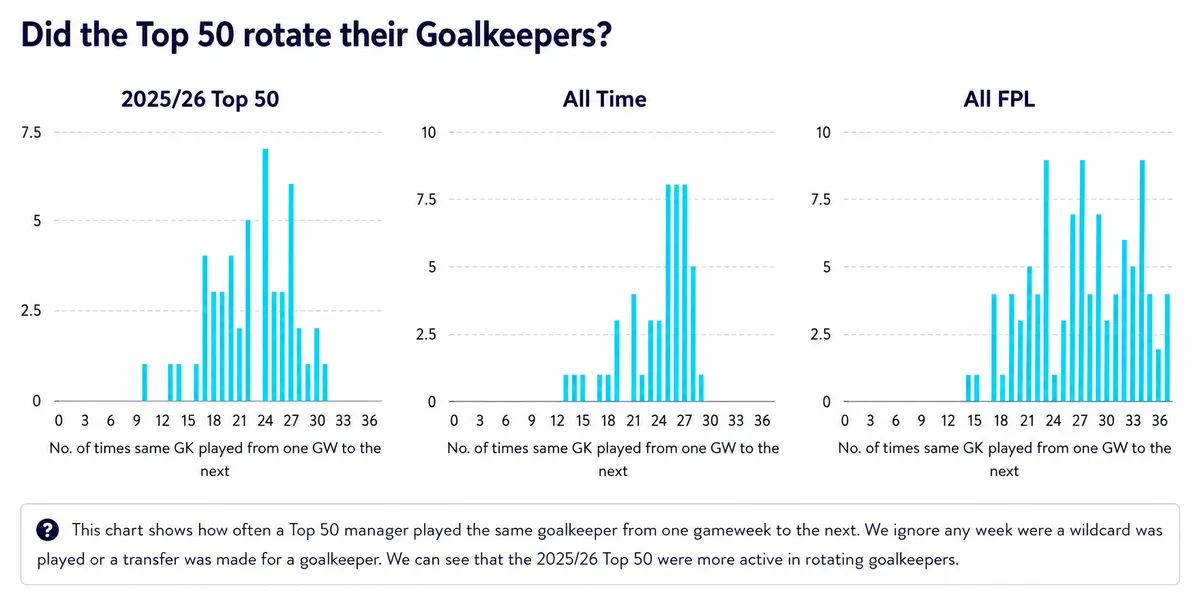
Goalkeeper rotation remained limited in 2025/26.
Both the 2025/26 Top 50 and All-Time Top 50 managers tended to keep the same goalkeeper from one Gameweek to the next for long stretches of the season. This fits with the wider trend we have seen across the Top 50 Strategy Guide, where managers were generally happy to back one reliable goalkeeper rather than rotate between two options.
David Raya was a major reason for that. Arsenal offered the strongest defensive platform in the league, keeping 19 clean sheets and conceding just 27 goals. Raya became a set-and-forget option for many managers, finishing as the top-scoring goalkeeper on 162 points.
That made rotation less appealing. When a goalkeeper offers strong clean-sheet potential most weeks, there is less incentive to switch based on fixture difficulty.
There were still cheap options available, with starting £4.0m goalkeepers such as Karl Darlow at Leeds and Martin Dúbravka at Burnley appearing during the campaign. But rather than creating widespread rotation, these players were mainly useful as budget enablers alongside a stronger first-choice keeper.
In short, managers were willing to spend on one dependable goalkeeper, but they were not regularly using transfers or bench decisions to rotate the position.
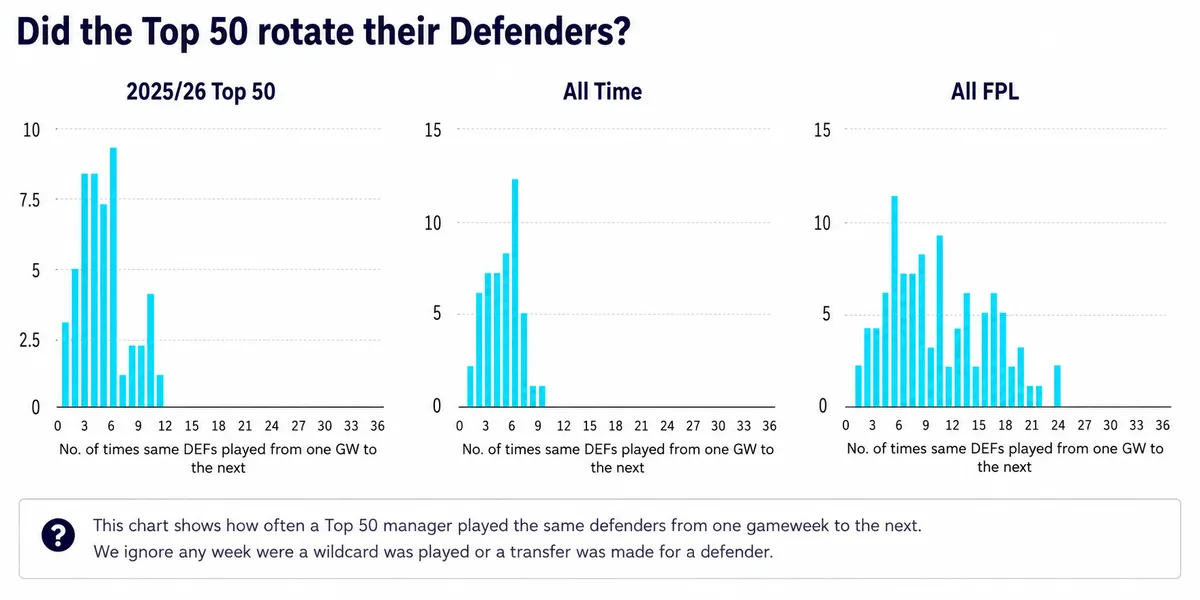
Defender rotation was much more common than goalkeeper rotation.
That is not surprising. Defenders are naturally more fixture-sensitive because clean sheets remain a major part of their scoring. Even with defensive contribution points improving their baseline, managers still had to consider opposition strength, home and away fixtures, and attacking threat.
The charts show that top managers changed their defensive line far more often than they changed goalkeepers. This points towards a flexible defensive setup, where one or two key players may have been trusted most weeks, while the remaining slots were rotated depending on fixture difficulty.
That flexibility was helped by the number of cheap defenders who became viable at different points of the season.
Maxime Estève started the campaign as a popular £4.0m option at Burnley, while Joe Rodon offered another cheap route into Leeds’ defence. Patrick Dorgu also became a useful option at Manchester United when he was playing further forward. His Gameweek 17 haul against Newcastle — goal, clean sheet and maximum bonus — showed the upside of a cheap defender with an advanced role.
Later in the season, James Hill emerged as a popular £4.0m option at Bournemouth. He was particularly useful because of DEFCON, with his defensive contribution points giving him a route to returns even when Bournemouth did not keep a clean sheet.
This was the key difference in 2025/26. Cheap defenders were not just bench fillers. Some were playable assets in the right fixtures, especially when they had secure minutes, DEFCON potential or an attacking role.
Rather than a fixed “Big at the Back” structure, the best managers appeared to use defence as a value and fixture-play area.
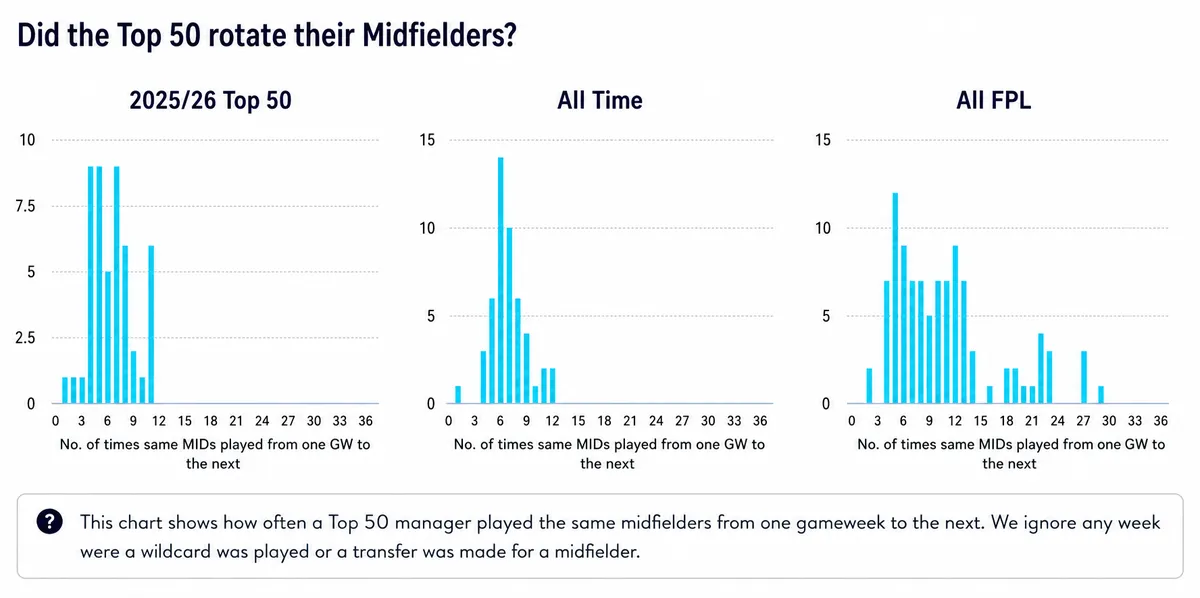
Midfield rotation was less of a major theme.
Traditionally, FPL managers prefer to avoid benching midfielders because they carry strong upside through goals, assists, clean-sheet points and bonus. In 2025/26, that remained largely true.
Unlike some previous seasons, there were not as many obvious cheap midfielders who made regular rotation feel like a clear strategy. Managers still needed midfield depth, but this was not a season where the fifth midfielder slot consistently offered the same level of playable value as some of the budget defenders.
That meant top managers were more likely to keep their key midfielders in place, especially when they owned reliable options such as Bruno Fernandes or other mid-priced players with strong minutes.
The charts still show some midfield rotation, but much of it was likely driven by fixture swings, injuries, minutes concerns and squad structure rather than a deliberate week-to-week rotation plan.
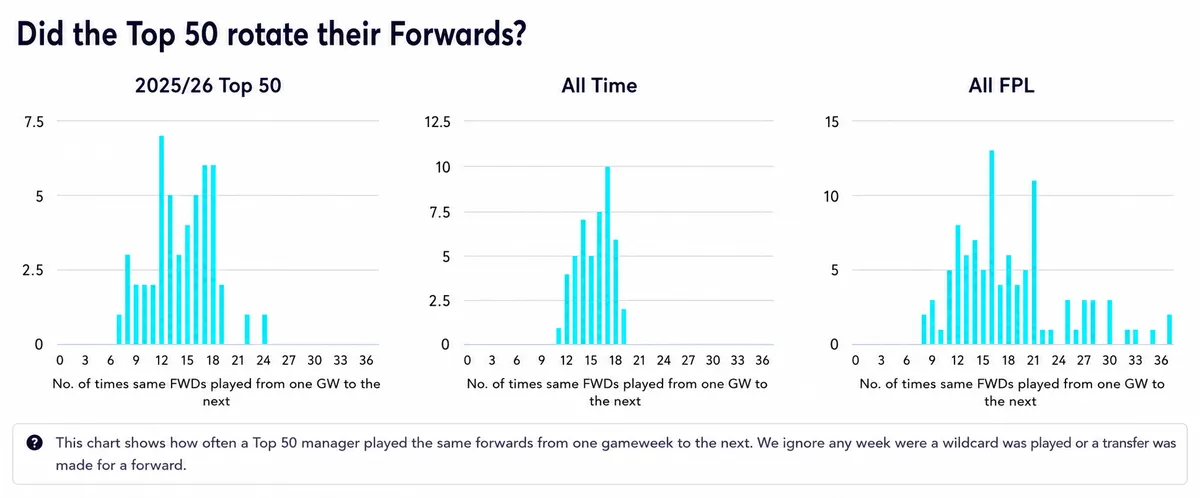
Forward rotation was more limited than defensive rotation, especially for managers who owned the key players.
Haaland was the obvious set-and-forget forward for most of the season. When managers owned him, he was almost always starting. His price, captaincy appeal, penalty duties and goal threat made benching him almost impossible to justify.
Thiago also became a reliable long-term hold for many managers. His price point and output made him a valuable squad piece, and for long periods he was not someone managers needed to rotate aggressively.
That meant forward rotation was often focused around the remaining slot, rather than the whole forward line. Managers could lock in Haaland, often keep Thiago, and then use the final place to respond to fixtures, form or availability.
This is different from defender rotation. Benching an attacker always carries more risk because goals can come in any fixture. While defenders often need clean sheets or DEFCON to justify selection, forwards can punish managers even in difficult matches.
As a result, the best managers appeared more willing to rotate defenders than forwards.
Final Thoughts
The 2025/26 rotation data shows that top managers did not treat every position the same.
Goalkeepers were mostly set-and-forget, especially once Raya became an obvious route into Arsenal’s defence. Cheap starting goalkeepers such as Darlow and Dúbravka helped squad structure, but they did not lead to widespread goalkeeper rotation.
Defenders were the main rotation position. Cheap options such as Estève, Rodon, Dorgu and Hill gave managers flexible ways to attack fixtures, while DEFCON made some low-cost defenders more playable than in previous seasons.
Midfield rotation was less prominent, partly because there were fewer obvious cheap midfielders worth regularly starting and benching.
Forwards were more settled, especially when managers owned Haaland and Thiago for long stretches of the campaign.
Key Takeaways:
Heading into 2026/27, rotation strategy will depend heavily on pricing. If there are several cheap defenders with secure minutes and DEFCON potential, defensive rotation could remain a key part of squad planning. But if value is harder to find, managers may return to a more fixed XI with less money left on the bench.

Unlock live Elite Team Reveals, AI transfer recommendations and all our Opta-powered planning tools with Premium Plus — now 63% off in our BIGGEST-EVER DISCOUNT.
Join 89% of our members who won their main mini-league last season.
TRY IT NOWAlready a Premium user? Login here
© fantasyfootballfix 2024 | Terms of Use | Privacy Policy | Contact Us