In this section of our Top 50 series, we analyse how the most successful Fantasy Premier League managers approached chip strategy throughout the 2025/26 season.
Following the removal of the Assistant Manager chip, managers received two sets of the traditional Wildcard, Free Hit, Triple Captain and Bench Boost chips. The first set had to be activated during the opening half of the campaign, before a second set became available for the run-in.
This created more opportunities to target favourable fixtures and Double Gameweeks, but placed even greater importance on choosing the correct moments to attack.
Using data from the 2025/26 Top 50 and our All-Time Top 50 managers, we examine when they activated their Bench Boost, Triple Captain and Free Hit chips across both halves of the season, highlighting the most popular Gameweeks and the key differences between the two groups.
The full range of Top 50 analysis can be found in the Preseason Pack, where users can also evaluate their own 2025/26 season and identify their strengths and weaknesses using the Skills Benchmark tool.
An interactive version of this graphic is available in the Preseason Pack.
The biggest strategic difference in 2025/26 was that managers could not save all their chips for the final third of the season.
The first set of chips had to be used before the Gameweek 19 deadline, which created a very different landscape compared to previous campaigns. Instead of waiting for late-season Double and Blank Gameweeks, managers had to find value earlier.
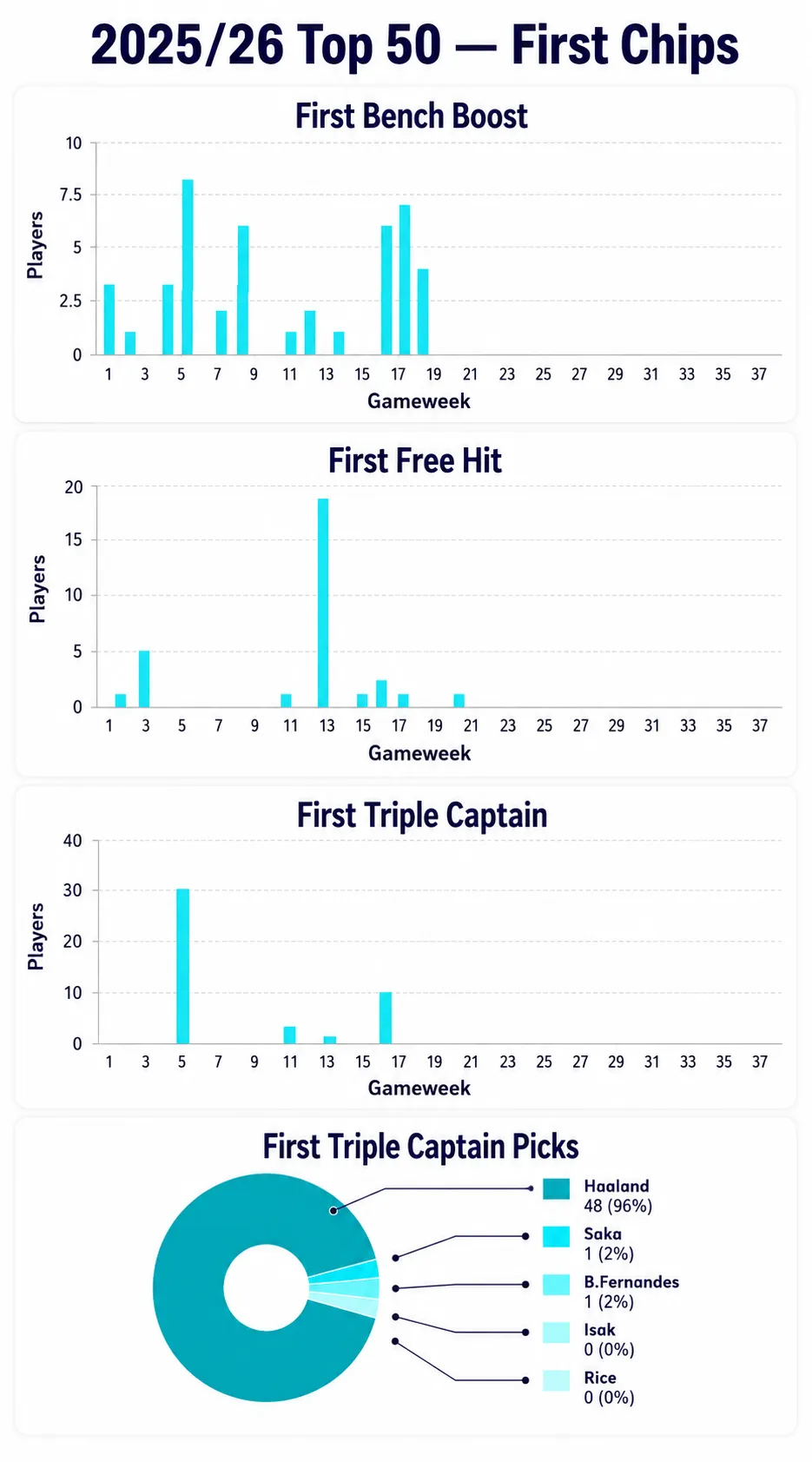
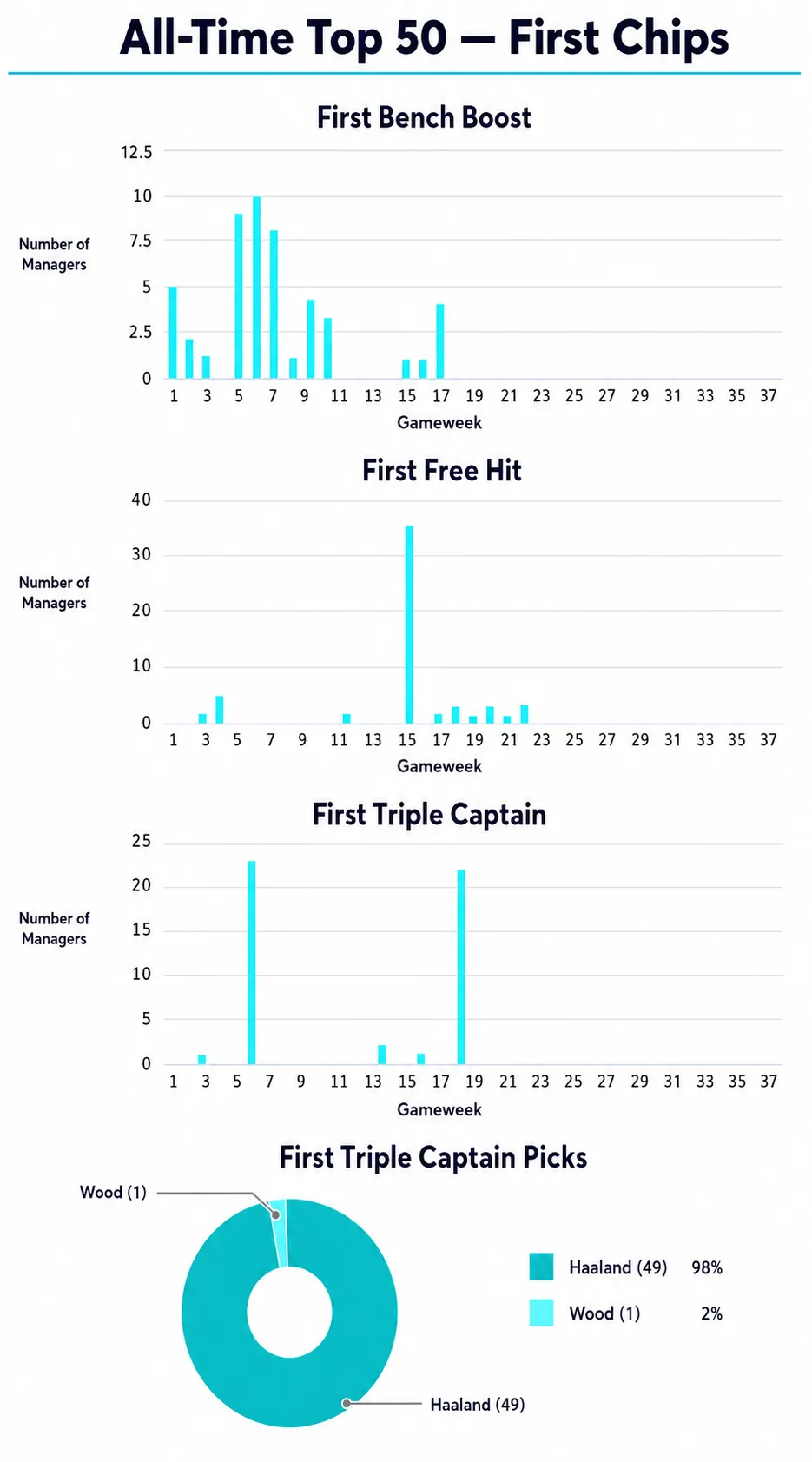
For Triple Captain, Gameweek 6 and Gameweek 17 stood out. Both centred around Erling Haaland.
In Gameweek 6, Manchester City beat Burnley 5-1, with Haaland scoring twice, assisting once and collecting all three bonus points. It was a classic premium captaincy fixture: an elite forward, at home, against a promoted side.
Gameweek 17 produced another strong Haaland return, as City beat West Ham 3-0. Again, Haaland scored twice, assisted once and picked up three bonus points.
In a season where the first set of chips had an expiry date, managers could not always afford to wait for a perfect Double Gameweek. A standout single Gameweek fixture became a much more valid play.
The first Free Hit was more varied, but Gameweek 13 was the major spike for both groups.
This was not a traditional blank Gameweek, but it did offer a clear opportunity to attack the fixtures. Man City hosted Leeds, making a triple-up on City assets an obvious route for managers looking to chase upside. Aston Villa also had a strong home fixture against a struggling Wolves side, while Brentford faced Burnley at home.
There was also a useful avoidance angle. Chelsea and Arsenal faced each other, which reduced the appeal of several highly owned players from both sides. For managers carrying multiple assets from those teams, the Free Hit offered a clean way to jump off them for one week without disrupting their long-term squad structure.
So rather than being used defensively, the Gameweek 13 Free Hit was largely an attacking play. Top managers used it to target high-upside fixtures, stack teams with favourable matchups and avoid a difficult fixture for popular Chelsea and Arsenal assets.
The Triple Captain chip is usually associated with premium attackers in Double Gameweeks, but 2025/26 delivered a more unusual pattern.
For the first chip, Haaland dominated. Gameweeks 6 and 17 were the key windows, and both worked well for those who backed him.
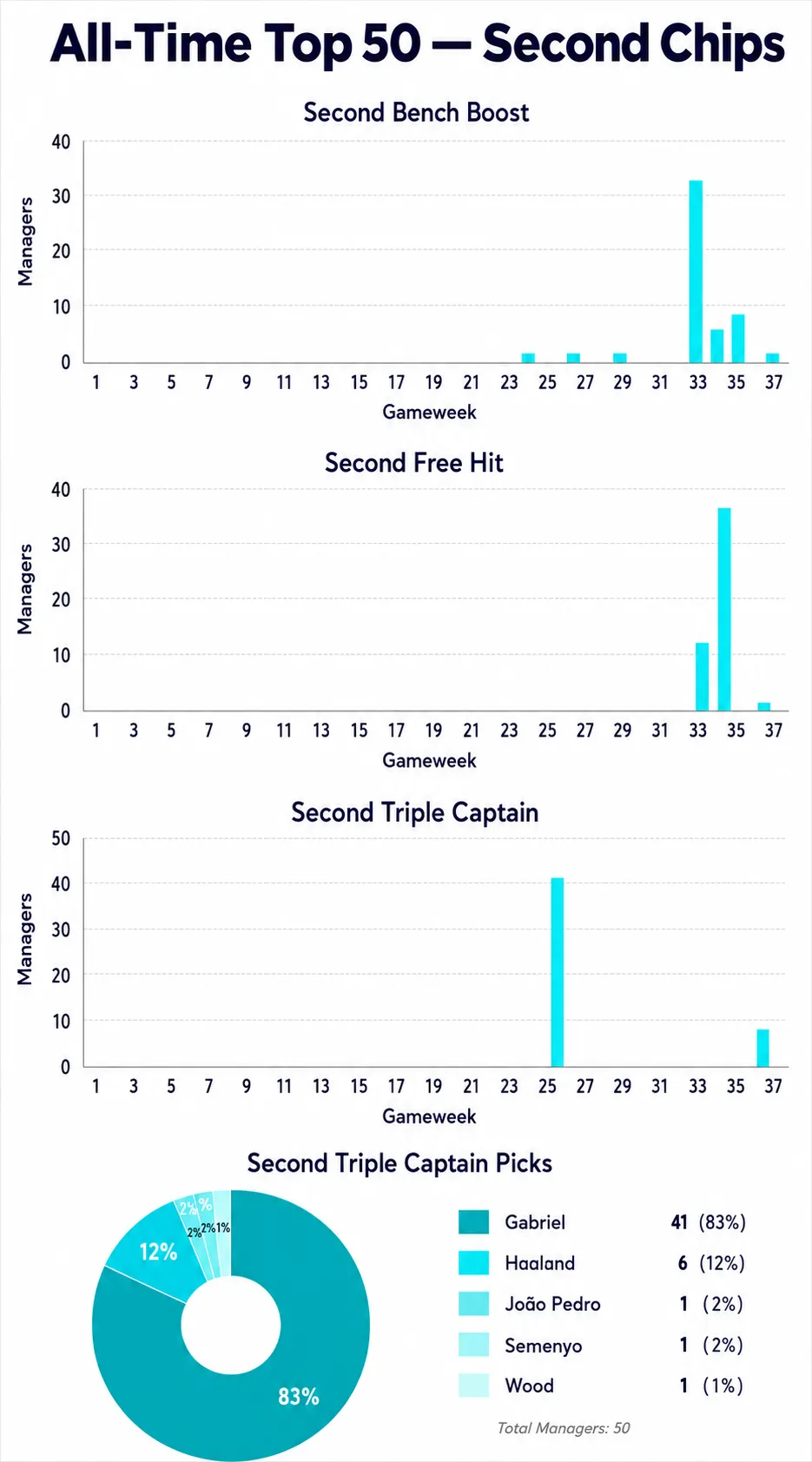
The second Triple Captain was more interesting.
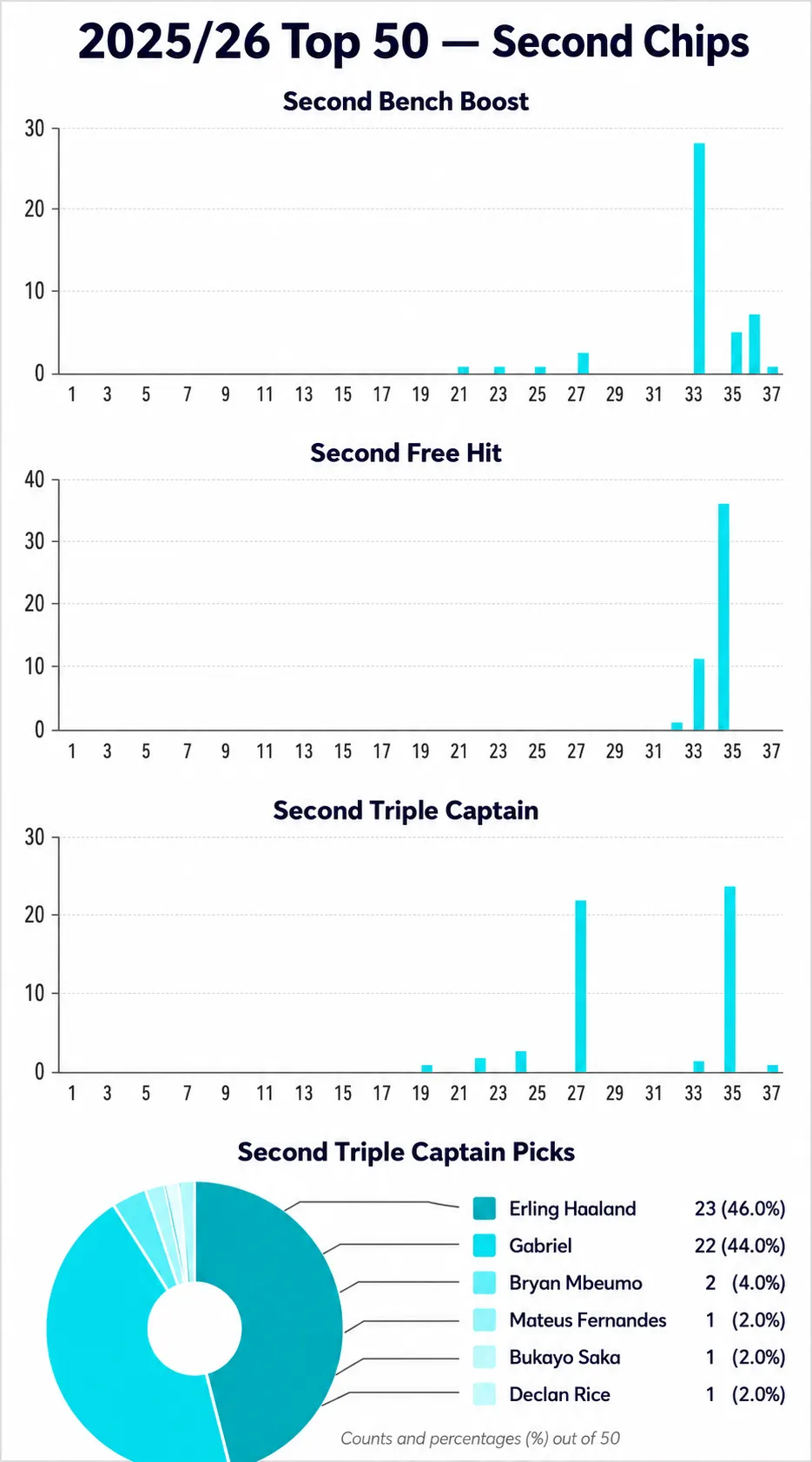
Among the 2025/26 Top 50 managers, the chip was split mainly between Haaland and Gabriel. Among the All-Time Top 50, Gabriel was even more dominant.
That tells us a lot about the season. Defensive contribution points changed how managers viewed defenders, and Gabriel became one of the standout FPL assets in the game.
Arsenal had a Double Gameweek 26 against Brentford and Wolves, which made Gabriel one of the more interesting second Triple Captain options.
The logic was clear. He had clean-sheet potential across two fixtures, strong set-piece threat, bonus appeal and the added safety net of defensive contribution points. In previous seasons, using Triple Captain on a defender would have felt extremely risky, but Gabriel’s 2025/26 profile made it easier to understand.
However, it ultimately failed to deliver the upside managers were hoping for. Arsenal conceded in both matches, drawing 1-1 with Brentford and 2-2 with Wolves, which removed the main route to a big defensive haul. Gabriel did pick up defensive contribution points against Brentford and an assist against Wolves, but a yellow card in the first match reduced his return further.
So while the decision highlighted how much DEFCON changed the way managers viewed defenders, it also showed the danger of using Triple Captain on a defensive asset. Without clean sheets or multiple attacking returns, the ceiling simply was not high enough to justify the risk.
There was also a late-season Haaland opportunity in Gameweek 36, when Manchester City had a Double Gameweek against Brentford and Crystal Palace. He scored, assisted and picked up two bonus points against Brentford in a 3-0 win, but did not feature against Palace. It was still a return, but it also showed the risk of late-season doubles when rotation becomes a major factor.
Verdict: Double Gameweeks still appeal, but the two-chip structure made strong single Gameweeks more attractive. Haaland remained the safest Triple Captain profile, while Gabriel showed that elite defenders could now enter the conversation.
The Free Hit chip remained one of the most schedule-driven chips in the game.
In the first half of the season, the Top 50 and All-Time Top 50 managers showed a clear concentration around Gameweek 13. Without a traditional late-season blank to wait for, many used the first Free Hit to attack a specific short-term opportunity.
The second Free Hit was far more predictable.
Gameweek 34 was the standout week, with a huge concentration of both the 2025/26 Top 50 and All-Time Top 50 managers using it then.
That was because Gameweek 34 followed directly after Double Gameweek 33. Man City, Burnley, Chelsea, Brighton, Leeds and Bournemouth all played twice in Gameweek 33, before blanking in Gameweek 34.
That created the classic FPL chip setup: load up on Double Gameweek players, then use the Free Hit the following week to escape the blank.
It is exactly the type of scenario where the Free Hit is at its most powerful. Managers could target the upside of Double Gameweek 33 without being left with several non-playing assets the week after.
Verdict: The Free Hit is still best used as a problem-solving chip. In 2025/26, Gameweek 34 was the obvious play because it allowed managers to attack the Gameweek 33 double without being punished by the blanks that followed.
The Bench Boost remained closely tied to Double Gameweeks, but the two-chip format created a more unusual spread.
The first Bench Boost was far more scattered, with managers using it across the opening half of the season. That was likely because there was no need to save it indefinitely, and because the first set of chips had to be used before Gameweek 19.
Some managers used the first Bench Boost early, while others waited until they had a deeper squad or a more favourable fixture run. The lack of a major early Double Gameweek meant there was no single obvious week for everyone.
The second Bench Boost was much clearer.
Gameweek 33 was the major spike for both groups, with many managers using it when Man City, Burnley, Chelsea, Brighton, Leeds and Bournemouth all had two fixtures.
This made sense. Bench Boost is at its strongest when managers can maximise minutes across all 15 players. A Double Gameweek gives more players the chance to play twice, which increases the ceiling of the chip.
There was also some usage in the final weeks of the season, particularly around Gameweeks 35 to 38. That likely came from managers who either missed the Gameweek 33 opportunity or preferred to use transfers later to build a strong 15-man squad.
Verdict: Bench Boost remains a Double Gameweek chip where possible. The first version required more flexibility, but the second version still followed the familiar pattern: build a squad, target the double, and try to maximise minutes.
The 2025/26 season changed chip strategy completely.
Managers no longer had one Bench Boost, one Triple Captain and one Free Hit to hold for the perfect moment. They had two of each, but the first set came with a deadline and had to be used in the opening half of the season.
That created two very different chip games.
In the first half, managers had to be more aggressive. Haaland single Gameweeks became strong Triple Captain opportunities, while the Free Hit and Bench Boost were used more flexibly.
In the second half, the familiar late-season rhythm returned. Double Gameweek 33 and Blank Gameweek 34 shaped the run-in, with Bench Boost and Free Hit usage heavily concentrated around those weeks.
Key Takeaways:
Looking ahead to 2026/27, the lesson is clear: chip timing still matters, but flexibility matters even more. Managers need to know when to wait for the schedule, when a single Gameweek opportunity is strong enough to attack, and when the upside is worth the risk.
The Elite XI: Team Reveal managers share over 80 Top 10k finishes between them.
Follow their every move and learn the strategies behind their success. Click here to get started!
Join 89% of our members who won their main mini-league last season.
TRY IT NOWAlready a Premium user? Login here
© fantasyfootballfix 2024 | Terms of Use | Privacy Policy | Contact Us