Captaincy can make or break an FPL season. Even with a strong squad and well-planned transfers, repeatedly choosing the wrong player for the armband can quickly damage your rank.
As part of our Top 50 series, we have analysed every captain selected by both the 2025/26 Top 50 managers and the All-Time Top 50. We reveal which players they trusted most, how frequently they followed the popular choice and whether taking calculated captaincy risks actually paid off.
You can also assess your own strengths ahead of the new season with our Skills Benchmark, included in the 2026/27 Preseason Pack.
Discover how your FPL decision-making compares across key areas such as captaincy, transfers and squad selection before finalising your Gameweek 1 team.
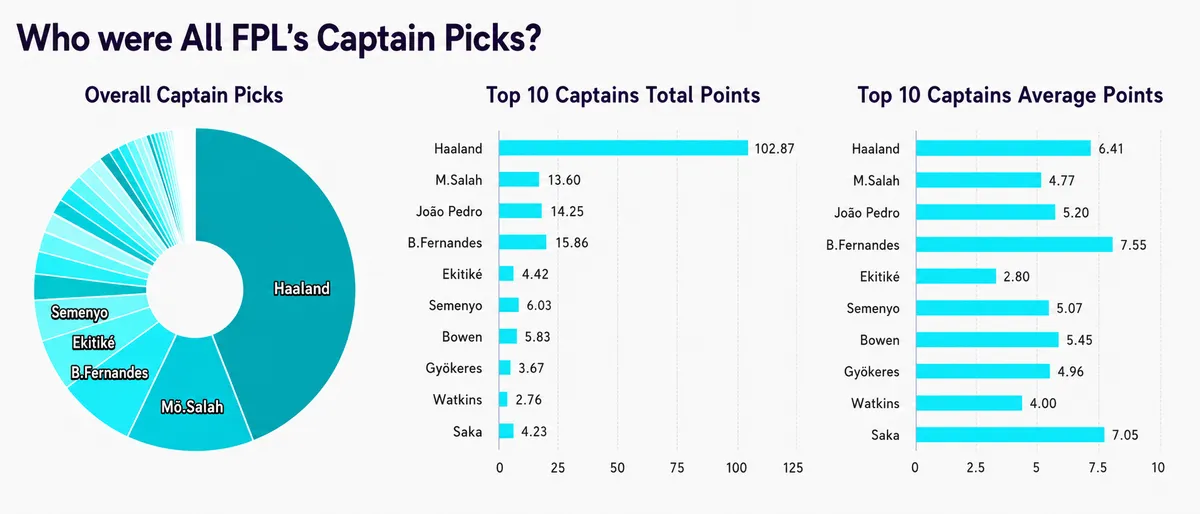
The 2025/26 Top 50 managers finished with an average of 574.3 captain points, ahead of the All-Time Top 50 managers on 549.5.
Interestingly, the All-Time Top 50 had a slightly higher captain success rate, at 24.9% compared with 23.3% for the 2025/26 Top 50. Captain success is defined as selecting the highest-scoring player in their squad as captain.
However, the 2025/26 Top 50 managers were marginally ahead when looking at captains scoring more than five points, with 57.5% compared with 56.0% for the All-Time Top 50.
That suggests the season’s best managers did not necessarily hit the absolute best captain more often, but they were slightly better at avoiding low-scoring captaincy outcomes.
Erling Haaland completely dominated captaincy in 2025/26.
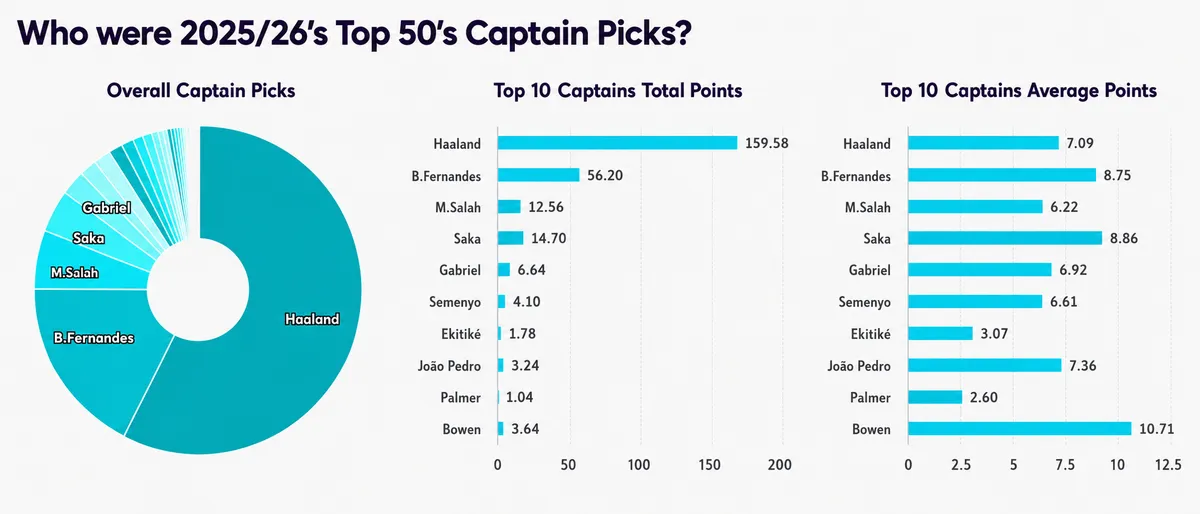
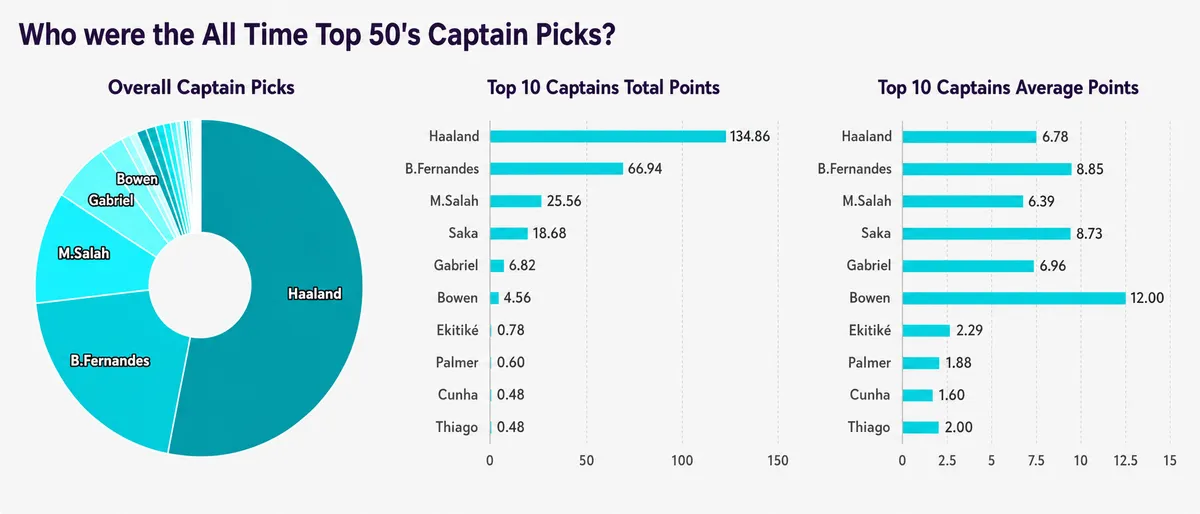
Among the 2025/26 Top 50 managers, Haaland accounted for 59.3% of captain picks. For the All-Time Top 50 managers, that figure was 53.5%.
That is a huge share, but it makes sense. Haaland finished as the top-scoring player in the game and was one of the few premium assets who consistently justified his price tag. In a season where several other expensive players struggled with form, fitness or minutes, he became the safest and most obvious captaincy route.
Bruno Fernandes was the clear second choice. He accounted for 16.9% of captain picks among the 2025/26 Top 50 and 20.3% among the All-Time Top 50.
That is important because it shows that top managers were not simply defaulting to Haaland every week. When the fixture, form or underlying numbers supported it, they were willing to move the armband to Bruno.
Mohamed Salah, Bukayo Saka, Gabriel and Antoine Semenyo were also used, but none came close to the Haaland and Bruno combination. Salah and Saka remained recognisable premium names, but both were less reliable than in previous seasons, while Gabriel’s presence reflects how much DEFCON changed perceptions around defender upside.
The total captain points chart shows just how heavily the season revolved around Haaland.
For the 2025/26 Top 50 managers, Haaland produced 159.58 captain points. Bruno Fernandes was next on 56.20, with Saka, Salah and Gabriel some way behind.
The same pattern appeared among the All-Time Top 50. Haaland produced 134.86 captain points, followed by Fernandes on 66.94 and Salah on 25.56.
This was not just about Haaland being the best player. It was also about trust. He was captained far more often than anyone else, which naturally drove his total captain points well clear of the rest.
When a player combines elite output, regular minutes, penalties, strong fixtures and captaincy security, top managers tend to converge. In 2025/26, Haaland was that player.
While Haaland dominated the volume, the average points chart tells a slightly different story.
For the 2025/26 Top 50 managers, Saka averaged 8.86 points when captained, just ahead of Bruno Fernandes on 8.75. Haaland averaged 7.09, while Gabriel also returned a respectable 6.92.
Among the All-Time Top 50, Bruno Fernandes averaged 8.85 points when captained, narrowly ahead of Saka on 8.73. Haaland averaged 6.78, while Gabriel averaged 6.96.
This highlights an important point. Haaland was the safest and most common captain, but he was not always the highest-upside pick in individual Gameweeks.
Bruno, in particular, rewarded managers who picked the right moments. His combination of penalties, creativity, bonus potential and Manchester United’s attacking reliance in the 2025/26 season made him an excellent alternative when the fixture was right.
Saka also performed well when trusted, although injuries and limited minutes meant he was not as frequent a captaincy option across the campaign.
Gabriel appearing among the leading captaincy options is one of the most interesting parts of the data.
Defenders are rarely serious captaincy candidates in FPL because clean sheets can disappear with one goal conceded, and attacking returns are less predictable than they are for midfielders and forwards.
But 2025/26 was different.
With defensive contribution points in play, Gabriel had more ways to score. He offered clean-sheet potential, set-piece threat, bonus appeal and DEFCON points, which made him a more credible captaincy option than a defender would usually be.
That said, the Triple Captain section of this series showed the risk clearly. Gabriel was a popular Triple Captain pick in Double Gameweek 26, but Arsenal conceded in both matches, limiting his ceiling. He still picked up points through DEFCON and an assist, but it was not the explosive return managers wanted.
The lesson is that DEFCON made defenders more viable, but captaincy still generally favours attackers. Gabriel’s inclusion shows how much the game changed, but also why managers need to be careful when chasing defender upside.
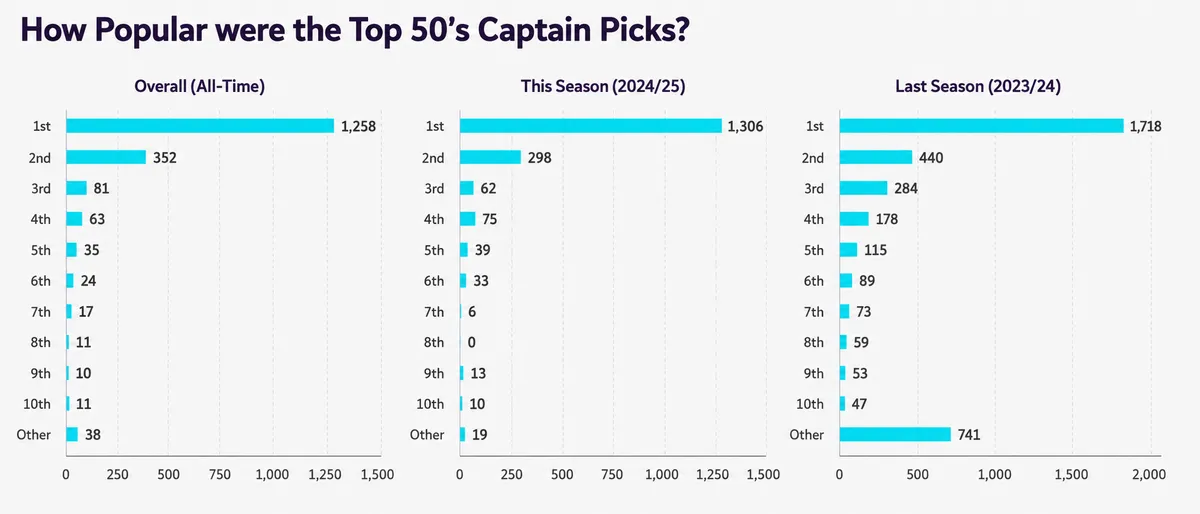
The data suggests that top managers still largely played captaincy safe.
For the 2025/26 Top 50 managers, their captain was the most popular overall pick 1,258 times. The second-most popular captain was selected 352 times, with a steep drop after that.
The All-Time Top 50 showed a similar pattern. Their captain was the most popular overall pick 1,306 times, with the second-most popular chosen 298 times.
That tells us that elite managers were not regularly chasing risky differentials with the armband. More often than not, they backed the obvious captain.
This does not mean they ignored upside. Fernandes, Saka, Gabriel and others were used when the situation suited. But the default approach remained sensible: captain the player with the strongest combination of fixture, form, minutes and ownership.
In a season where Haaland was so dominant, going against him too often was a major risk.
The 2025/26 captaincy data shows a season shaped by two main players.
Haaland was the dominant captain, accounting for 59.3% of captain picks among the 2025/26 Top 50 managers and 53.5% among the All-Time Top 50. He was the safe, high-volume option and the player most managers trusted when there was no obvious reason to look elsewhere.
Bruno Fernandes was the main alternative. He was captained less often, but delivered excellent average returns when trusted, especially for managers who picked the right fixtures.
The wider lesson is clear: top managers do not take unnecessary captaincy risks. They usually follow the best option, even if that option is also the most popular. The edge comes from knowing when to stay with the crowd and when the data supports a move elsewhere.
Key Takeaways:
Heading into 2026/27, the message is simple: captaincy is still a game of probabilities. Most weeks, the best play is likely to be the obvious one — but the biggest gains come when you know exactly when to move away from it.
Unlock live Elite Team Reveals, AI transfer recommendations and all our Opta-powered planning tools with Premium Plus.
Join 89% of our members who won their main mini-league last season.
GET PREMIUM FOR £1Already a Premium user? Login here
© fantasyfootballfix 2024 | Terms of Use | Privacy Policy | Contact Us