Wildcards remain arguably the most powerful chips in Fantasy Premier League, allowing managers to make unlimited transfers, completely reshape their squad structure and prepare for future chip strategies.
For this latest article in our Top 50 series, we have analysed how the 2025/26 Top 50 managers and the All-Time Top 50 timed both of their Wildcards.
Wildcard strategy became even more important following the introduction of the new chip format. With the Assistant Manager chip removed, managers were instead given two sets of the traditional chips: Wildcard, Free Hit, Triple Captain and Bench Boost.
The first Wildcard had to be used before the Gameweek 19 deadline, while the second became available for the latter half of the campaign. This created two very different opportunities: an early-season reset and a later Wildcard often used to prepare for the Double and Blank Gameweek period.
We reveal the most popular Wildcard windows among the best FPL managers, how their strategies differed and what you can learn for the upcoming season.
You can also analyse your own 2025/26 campaign and see how your performance compares with other managers using the Skills Benchmark tool.
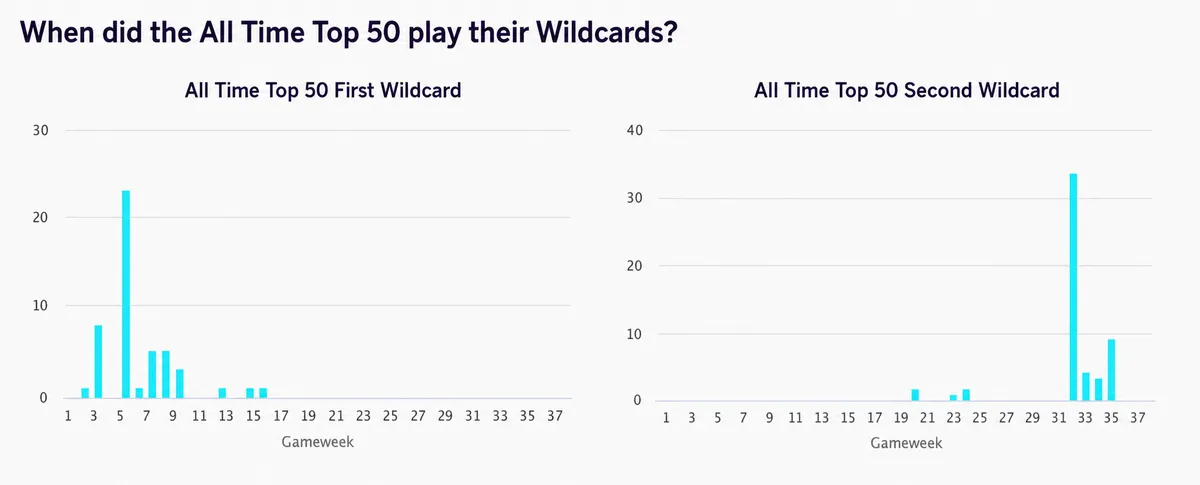
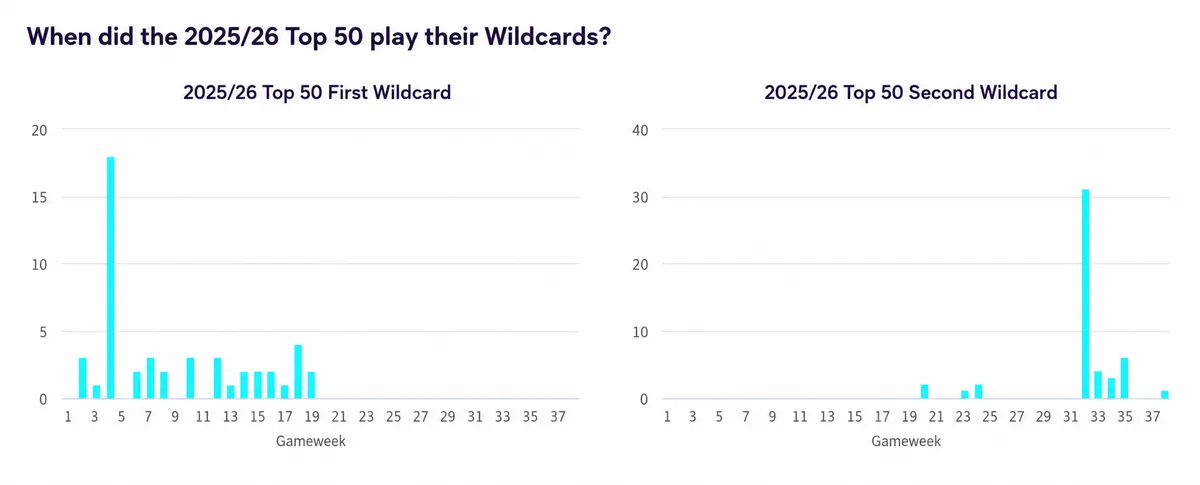
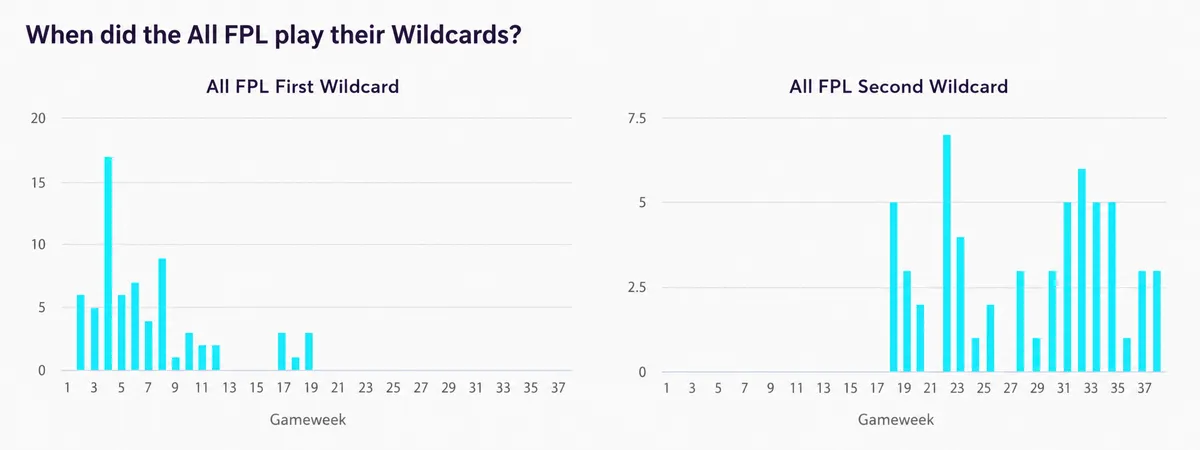
The first Wildcard was heavily concentrated in the early part of the season, but there was a clear difference between the two groups.
Among the 2025/26 Top 50 managers, Gameweek 4 was the most popular time to activate the first Wildcard. This came immediately after the first international break of the season, which ran from 1 September to 13 September.
That timing makes sense. International breaks are often popular Wildcard windows because managers have more time to assess early-season information, react to injuries and price changes, and plan around fixture swings. By that point, managers had already seen three Gameweeks of data, which was enough to reassess pre-season assumptions.
However, the All-Time Top 50 managers were more concentrated around Gameweek 6. That suggests the more historically proven managers were slightly more patient, waiting for a larger sample of information before making their first major squad reset.
By Gameweek 6, early bandwagons were clearer, player roles were more reliable and fixture trends had started to settle. This made it easier to separate short-term noise from genuine long-term value.
Using the first Wildcard early allowed managers to:
The spread after those early spikes is also interesting. Some managers delayed until Gameweeks 7 to 10, while others held until the final few weeks before the Gameweek 19 deadline. That shows there was still flexibility, but the overall trend was clear: most top managers were comfortable using the first Wildcard early rather than saving it too long.
In previous seasons, managers often debated whether to hold the first Wildcard for a larger fixture swing later in the autumn.
In 2025/26, the chip deadline changed the calculation.
The first Free Hit and Triple Captain also had to be used in the same half of the season, which made the first Wildcard more valuable as a setup tool. It was not only about fixing problems. It was also about building a squad that could attack the next run of fixtures and support other chip decisions.
For many managers, Gameweek 4 offered the right balance. It was early enough to gain value from the reset, but late enough to have meaningful data on player roles, team form and emerging options.
The second Wildcard was even more concentrated.
Both the 2025/26 Top 50 managers and the All-Time Top 50 managers showed a huge spike in Gameweek 32.
This was the key strategic moment of the run-in. Managers were not simply using the Wildcard to fix their squads — they were using it to build a chip plan.
Gameweek 32 gave managers the chance to prepare for Double Gameweek 33, where Man City, Burnley, Chelsea, Brighton, Leeds and Bournemouth all had two fixtures.
That made it an ideal time to reshape the squad around players with extra fixtures, while also planning for the Blank Gameweek that followed.
The most common late-season route was clear:
This was classic FPL chip sequencing.
The Gameweek 32 Wildcard allowed managers to build a squad with strong Double Gameweek 33 coverage. The Bench Boost then maximised the value of that squad by using all 15 players when several teams had two fixtures.
The Free Hit in Gameweek 34 solved the problem created by the same teams blanking straight after the double.
This is why the second Wildcard became so heavily concentrated. Once Double Gameweek 33 and Blank Gameweek 34 were clear, there was an obvious route for managers to follow.
Rather than using the Wildcard in isolation, the best managers used it as the starting point for a three-chip strategy.
The 2025/26 season also continued a wider trend: fewer major Blank and Double Gameweek opportunities than managers were used to in older seasons.
The FA Cup calendar is now more structured, with protected weekends and fewer unexpected fixture changes. That means there are often fewer large-scale blanks and doubles, and when they do arrive, they are usually more clearly signposted.
As a result, there was less incentive to take an unusual Wildcard route.
When Gameweek 32 clearly set up Double Gameweek 33 and Blank Gameweek 34, many top managers naturally landed on the same strategy. The edge was less about finding a completely different chip path and more about building the best possible squad within the obvious one.
The two Wildcards had very different purposes in 2025/26.
The first Wildcard was mainly about reacting. Managers used it to fix early mistakes, jump on emerging players and adapt to the first few weeks of information.
The second Wildcard was mainly about planning. Managers used it to prepare for Double Gameweek 33, Bench Boost their full squad and avoid the Gameweek 34 blanks with the Free Hit.
That distinction is important.
The first Wildcard rewarded managers who were willing to be proactive. The second rewarded managers who understood the wider chip structure and timed their squad reset around the fixture calendar.
The 2025/26 Wildcard data shows how important timing remains at elite level.
Gameweek 4 was the key first Wildcard window, with many top managers choosing to reset early once the opening weeks had revealed enough information.
Gameweek 32 was the dominant second Wildcard window, acting as the launchpad for the Bench Boost in Gameweek 33 and the Free Hit in Gameweek 34.
Key Takeaways:
Looking ahead to 2026/27, the lesson is clear: the Wildcard is not just a reset button. Used well, it can shape your entire chip strategy.
Follow first drafts and live team changes from our Elite XI: Team Reveal managers.
Unlock Premium Plus for £1 now — cancel anytime. 🔓
Join 89% of our members who won their main mini-league last season.
GET PREMIUM FOR £1Already a Premium user? Login here
© fantasyfootballfix 2024 | Terms of Use | Privacy Policy | Contact Us