Transfers are one of the most important tools at an FPL manager’s disposal. Each Gameweek brings a chance to improve the squad, react to injuries, target fixtures and move early on emerging value.
But every extra transfer beyond your available free moves comes at a cost. This section explores how the top-performing managers approached transfers across the 2025/26 season: when they made them, what influenced their decisions, how often they took hits and whether they chased price changes, points or differentials.
This article is part of our Top 50 Series, analysing how the best-performing Fantasy Premier League managers from 2025/26—and the All-Time Top 50—navigated the season.
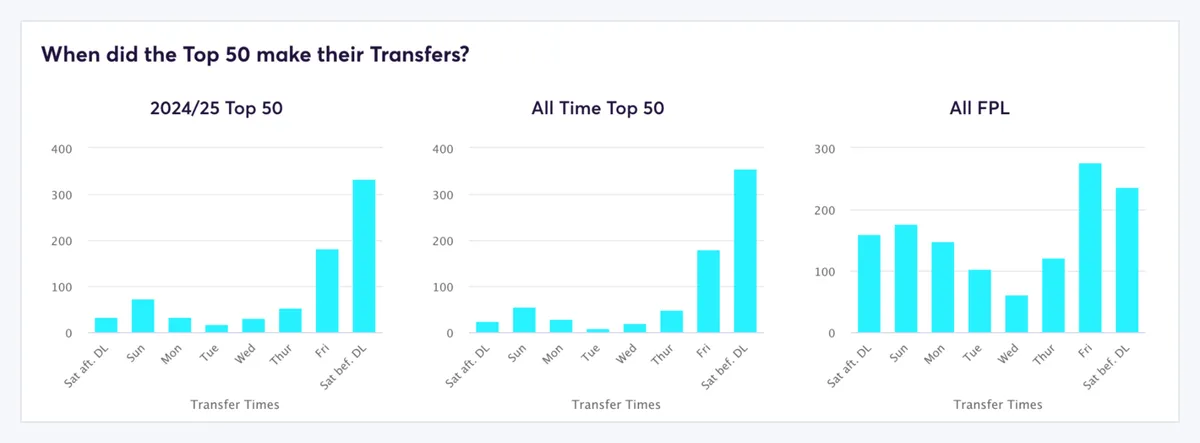
The data shows that top managers continued to favour patience.
Both the 2025/26 Top 50 and All-Time Top 50 made a large share of their transfers late in the week, particularly on Friday and on Saturday before the deadline.
This is an important difference compared with the wider FPL player base. All FPL managers were more spread across the week, with a larger number of transfers made earlier, especially on Sunday and Friday.
Delaying transfers offers several key advantages:
The trend is clear. Top managers generally prefer information over speed. They are willing to risk missing a price change if it means making a better-informed decision closer to the deadline.
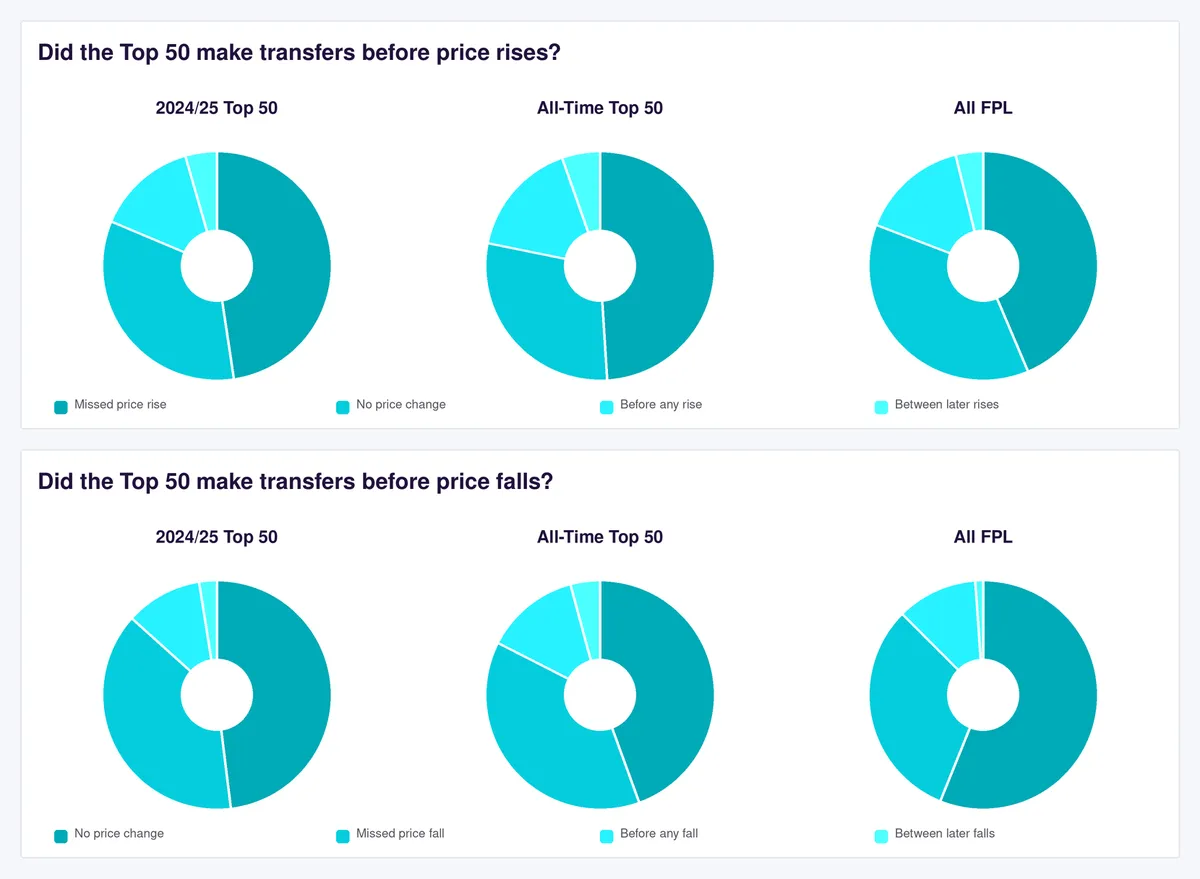
Price rises remain a major talking point in FPL, especially early in the season when team value can feel important. However, the data shows that the best managers were not overly driven by them.
The 2025/26 Top 50 were more likely than the All-Time Top 50 and All FPL managers to bring in players who were rising in price, but they still missed plenty of price rises.
That suggests a balanced approach. They were aware of price movement, but not ruled by it.
The same pattern appeared with price falls.
A large share of transfers out had no immediate price change attached, while many managers were also prepared to miss a price fall rather than sell too early.
This is important. Team value matters, but it is not the main priority. The best managers are usually more interested in points, fixtures, role and team news than protecting £0.1m of squad value.
That does not mean price changes are ignored completely. If a move is already planned and there is no meaningful risk in going early, acting before a rise or fall can make sense. But the data suggests top managers were not forcing transfers purely because of price movement.
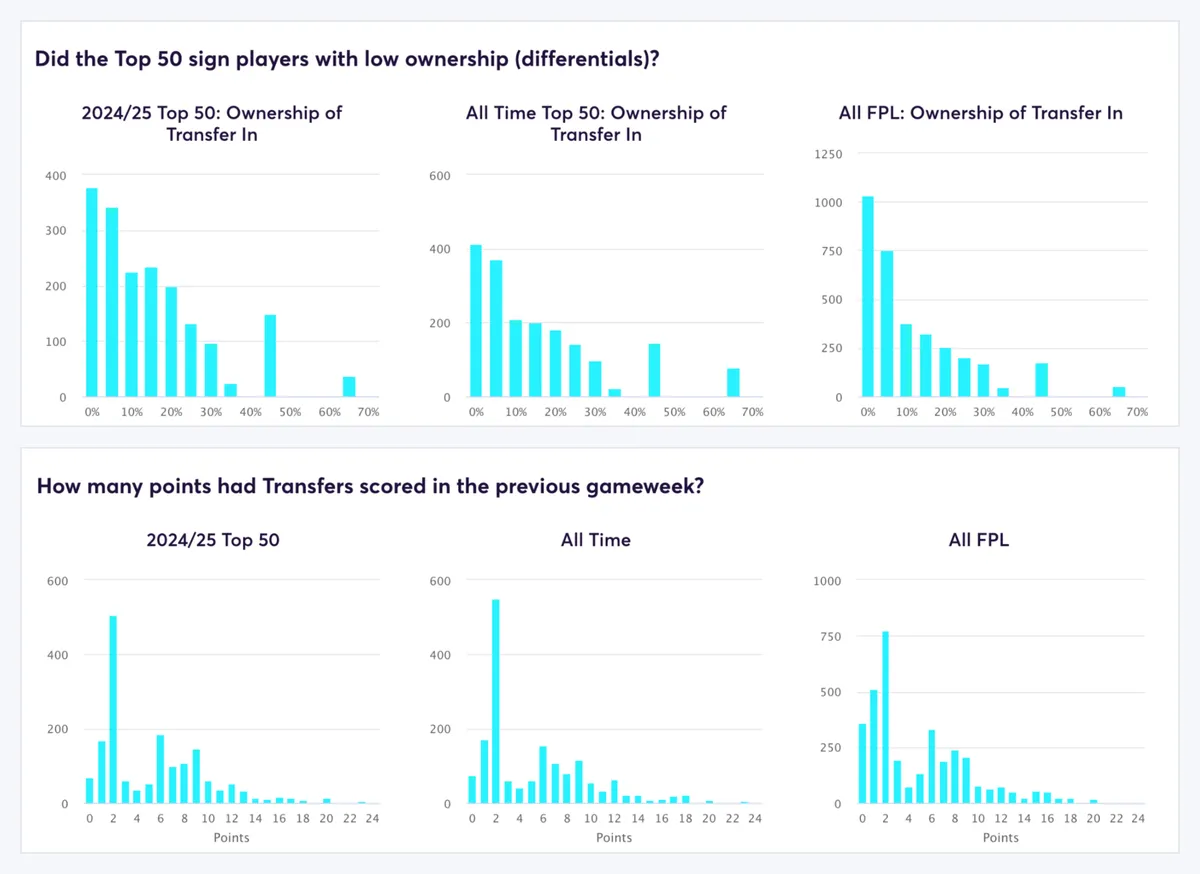
Yes — but not necessarily in a reckless way.
The ownership data shows that a large share of transfers made by the 2025/26 Top 50 and All-Time Top 50 were for players owned by fewer than 20% of managers.
For the 2025/26 Top 50, the biggest transfer-in bands were around 0%, 5%, 10% and 15% ownership. The same was true for the All-Time Top 50, with the 5% ownership band especially prominent.
This shows that top managers were regularly willing to move before the wider player base. They were not simply buying the most obvious template player every week.
However, this should not be confused with chasing low ownership for the sake of it. Many of these players were likely emerging value picks, fixture plays or players whose underlying numbers had improved before mass ownership caught up.
It is also worth remembering that overall ownership can be misleading, especially later in the season when many teams become inactive. A player who looks like a differential across all FPL may be much more popular among engaged managers.
The takeaway is not “buy differentials”. It is “buy good players before they become obvious”.
The data suggests they did not.
The most common previous Gameweek score for transferred-in players was 2 points across the 2025/26 Top 50, All-Time Top 50 and All FPL.
That is an important finding. It shows that top managers were not simply buying players because they had just hauled.
There were still plenty of transfers in for players who had scored more than five points in the previous Gameweek, but the overall pattern suggests managers were looking beyond the most recent score.
That is exactly how strong FPL decision-making should work. One Gameweek return can be noisy. A player might score from one low-quality chance, get lucky with bonus, or benefit from a one-off situation.
The best managers appear to focus more on:
This is one of the clearest signs of disciplined transfer behaviour. They were not ignoring form, but they were not blindly chasing last week’s points either.
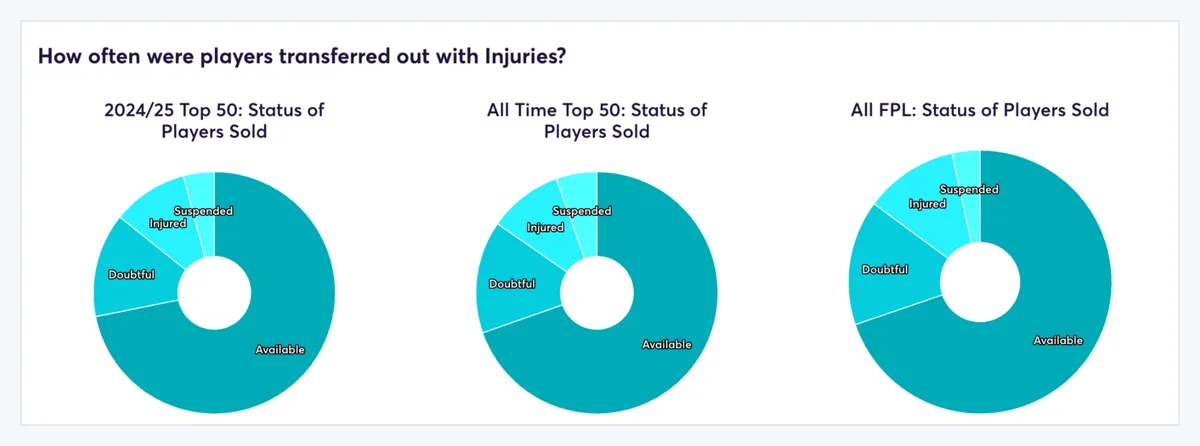
Injuries and availability clearly played a role, but they were not the only reason top managers made transfers.
For the 2025/26 Top 50, 74.3% of players sold were available, while 13.0% were doubtful and 10.5% were injured.
The All-Time Top 50 showed a very similar pattern: 74.1% of players sold were available, 12.7% were doubtful and 11.3% were injured.
That means around a quarter of transfers out were linked to players who were doubtful, injured or suspended, but the majority were still available.
This tells us something important. Top managers were not only making forced moves. Many transfers were proactive decisions based on fixtures, form, role, structure or future planning.
There is a balance here. When a player is clearly injured or suspended, selling can be straightforward. But when a player is only doubtful, top managers often have to decide whether the transfer is worth using, especially if their bench can cover.
The data suggests they were willing to move when needed, but they were not constantly burning transfers just because a player had a short-term flag.
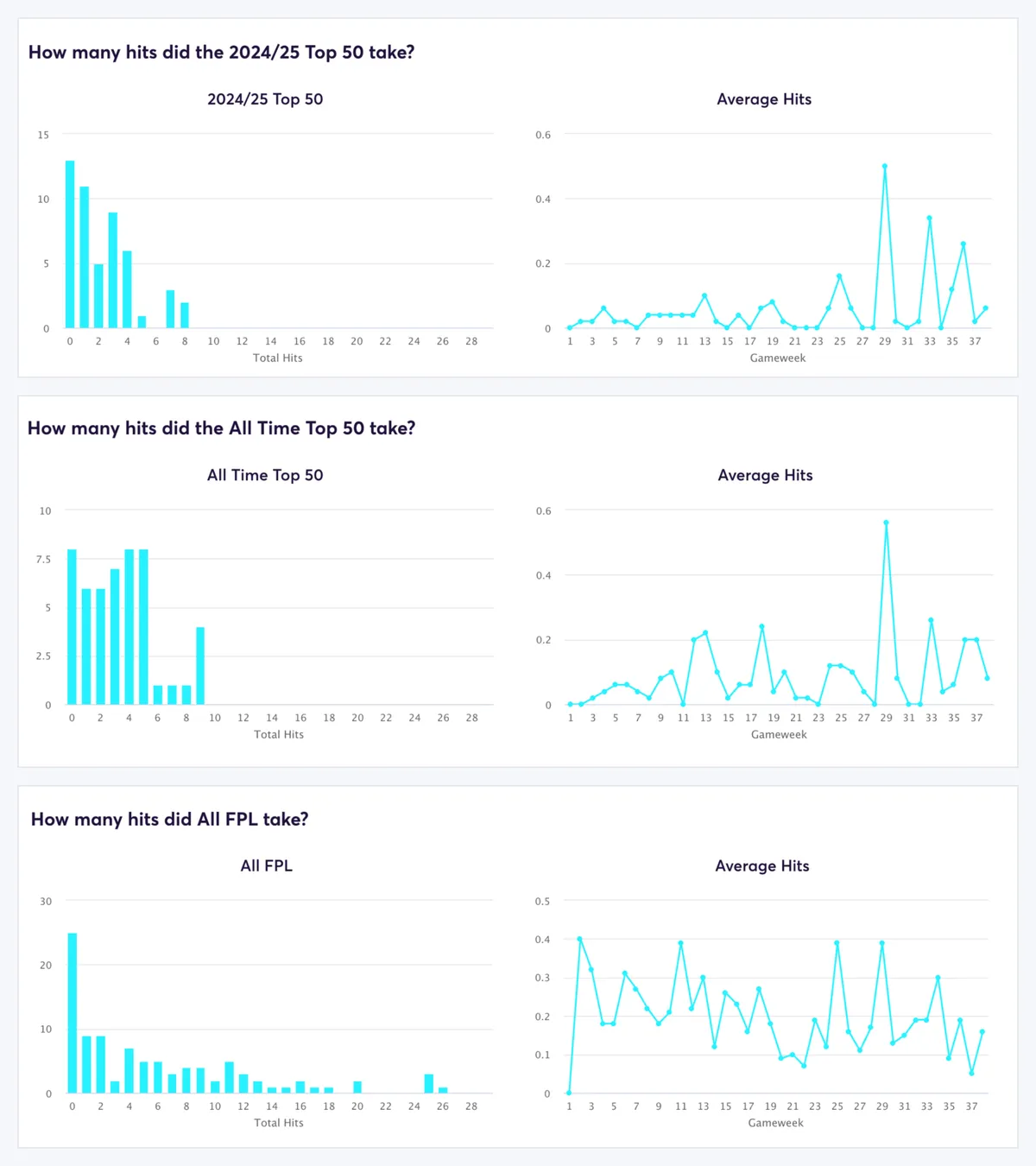
Transfer hits were used sparingly.
Among the 2025/26 Top 50 managers, the most common outcome was taking no hits at all. A large number also took just one or two across the entire season, with very few managers going beyond six.
The All-Time Top 50 were slightly more willing to take hits, with a wider spread including managers who took three, four, seven, nine or ten across the season. Even so, the overall message remained the same: hits were not used casually.
This is one of the biggest differences between strong FPL managers and more reactive players. A hit needs to clear a four-point penalty before it becomes worthwhile. That usually requires either an immediate upside, a longer-term structural gain, or a way to navigate a major fixture problem.
In 2025/26, the Top 50 managers generally avoided unnecessary hits. When they did take them, it was likely because there was a clear strategic reason.
The average hits chart shows small spikes through the season, but the biggest increase came in Gameweek 38.
That makes sense. Gameweek 38 often encourages season-end punts. With no future Gameweeks to plan for, managers can afford to be more aggressive. There is no need to preserve squad structure, save transfers or worry about long-term consequences.
This makes late-season hits different from hits earlier in the campaign. A Gameweek 38 hit is often about chasing upside, protecting rank or making a final push in mini-leagues.
Earlier in the season, hits were much more limited. That suggests top managers were generally patient and preferred to use free transfers unless there was a clear reason to be more aggressive.
The 2025/26 transfer data shows a familiar pattern among the best FPL managers: patience, discipline and evidence-led decision-making.
They generally waited until late in the week before making transfers, prioritising team news and fixture clarity over early price movements.
They were not afraid to buy lower-owned players, but this was not reckless differential chasing. It was more about identifying good options before they became obvious.
They did not simply chase last week’s points either. The most common previous score for transferred-in players was 2 points, showing that top managers looked beyond recent returns.
They also kept hits to a minimum. The 2025/26 Top 50 were especially conservative, with many taking no hits or only one or two across the season.
Key Takeaways:

Unlock live Elite Team Reveals, AI transfer recommendations and all our Opta-powered planning tools with Premium Plus.
Join 89% of our members who won their main mini-league last season.
TRY IT NOWAlready a Premium user? Login here
© fantasyfootballfix 2024 | Terms of Use | Privacy Policy | Contact Us