
Is Gameweek 2 too early to play your FPL Wildcard?
One round of matches is a very small sample, but we already know more about player roles, set pieces and starting line-ups than we did before the opening deadline.
An early Wildcard could be particularly appealing to managers who used their Bench Boost in Gameweek 1. With the chip already out of the way, money can be moved off the bench and invested in the starting XI.
Using our Assistant Manager tool, we have created an AI FPL Gameweek 2 Wildcard and mapped out its team selection and captaincy plan through to Gameweek 6.
Before revealing the full squad, let’s assess the arguments for and against activating the Wildcard this early.
The decision should depend on the structure of your squad rather than your Gameweek 1 score.
A disappointing opening weekend doesn’t automatically make your original selections poor picks. However, if your squad was designed specifically for a Gameweek 1 Bench Boost or already requires four or five changes, the Wildcard becomes much easier to justify.
Managers who Bench Boosted in Gameweek 1 needed two playing goalkeepers and reliable options throughout their squad.
Once that chip has been used, there is less need to keep so much money on the bench. A Wildcard allows those funds to be redirected towards a stronger starting XI, premium captaincy options and players with better medium-term fixtures.
A strong Wildcard shouldn’t simply target the next deadline.
The Assistant Manager has planned every starting line-up through to Gameweek 6, including defensive rotations and captaincy changes.
Gameweek 1 provided useful clues about tactical roles and set pieces.
Dominik Szoboszlai took and converted Liverpool’s penalty while also being heavily involved in corners and free-kicks. Those are potentially sustainable routes to points rather than simply chasing his opening-week score.
We also gained more information about defensive contribution potential, expected minutes and which new signings have immediately become important to their teams.
If your squad has several injured players, uncertain starters or too much money tied up in the wrong positions, a Wildcard can solve everything at once.
It also avoids spending the next three or four Gameweeks using transfers to gradually reach a squad you could own immediately.
The biggest risk is overreacting to 90 minutes of football.
A player who hauled in Gameweek 1 may not continue producing at that level, while a strong FPL option can easily blank despite playing well. There is still a danger of buying last week’s points.
Waiting would provide more evidence on starting line-ups, set-piece takers, defensive contributions and tactical roles.
The transfer window also remains open, while the international break could produce injuries or changes in expected minutes.
Playing the Wildcard now means it won’t be available when injuries, suspensions or a larger fixture swing create a more obvious opportunity.
Managers with a good underlying squad may be better off addressing one or two problems with free transfers.
Manchester United’s opening defeat was disappointing, but Bruno Fernandes and Bryan Mbeumo still have the quality and fixtures to deliver.
A poor team performance doesn’t necessarily mean every player from that side should immediately be sold. The AI draft itself retains both players, demonstrating the importance of looking beyond a single result.
The chip could make sense if:
Holding is probably preferable if your squad remains structurally sound and its players still have favourable fixtures.
The Assistant Manager has produced a complete Gameweek 2 Wildcard for those ready to make the move, including a five-Gameweek rotation plan.
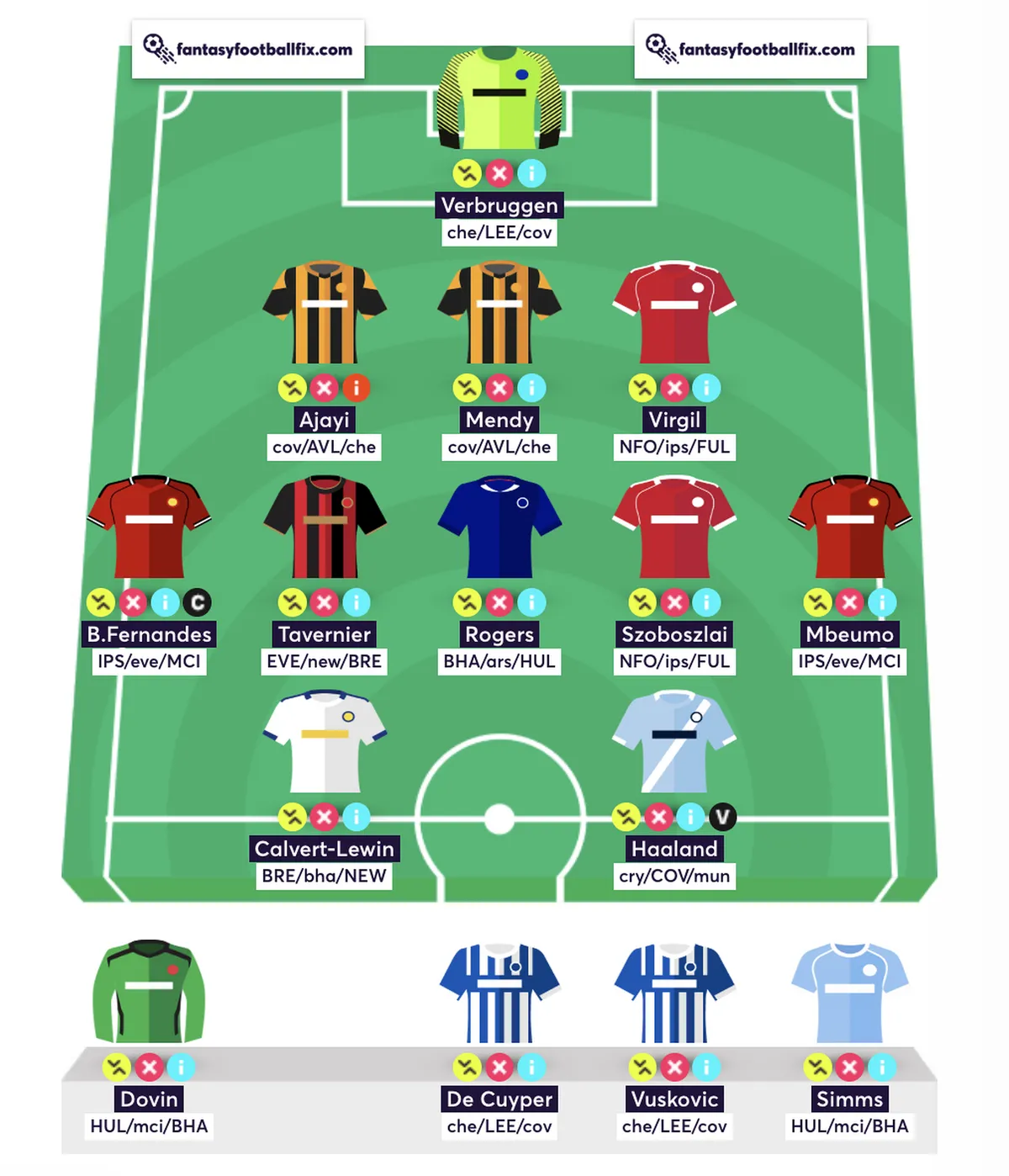
The Gameweek 2 Wildcard selected by the Fantasy Football Fix Assistant Manager.
This squad is particularly well suited to managers who have already used their Bench Boost.
The AI plans to start Bart Verbruggen in every Gameweek, allowing Oliver Dovin to occupy the second goalkeeper spot as a £4.0m non-playing option.
This frees up more of the budget for Erling Haaland and a strong five-man midfield featuring Bruno Fernandes and Bryan Mbeumo.
Managers saving their Bench Boost for later may prefer to own two playing goalkeepers. The draft can easily be adjusted in the Assistant Manager by upgrading Dovin and allowing the AI to rebalance the rest of the squad.
The rotation table is arguably more important than the initial Gameweek 2 team because it reveals why certain players have been selected.
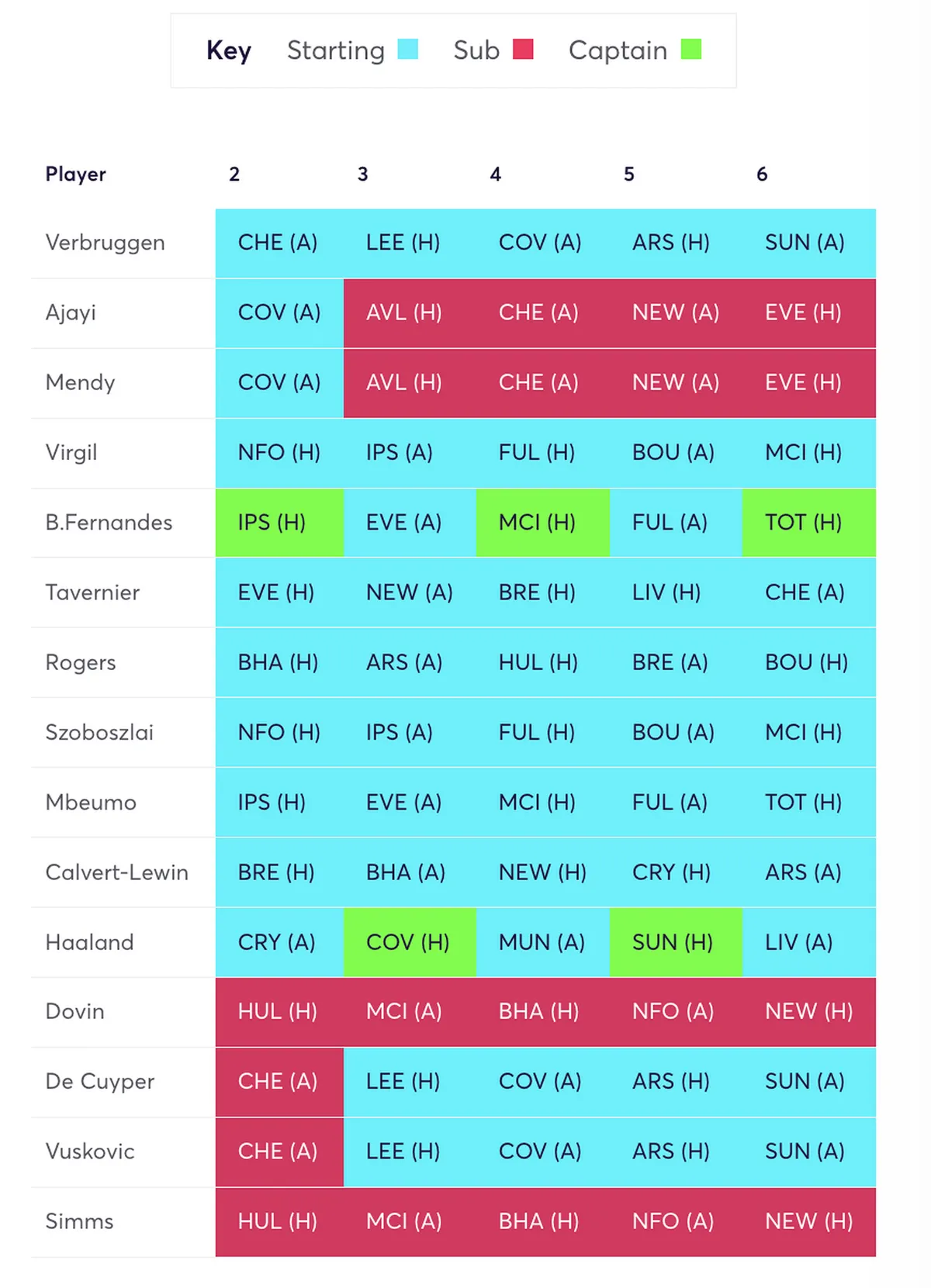
The Assistant Manager’s planned line-ups and captains from Gameweek 2 to Gameweek 6.
Semi Ajayi and Nobel Mendy start away to Coventry in Gameweek 2, allowing Maxim De Cuyper and Luka Vuskovic to remain on the bench for Brighton’s difficult trip to Chelsea.
The rotation changes in Gameweek 3, when both Brighton defenders enter the starting XI for the following run:
With Bart Verbruggen already starting in goal, introducing De Cuyper and Vuskovic creates a Brighton defensive triple-up.
The fixtures against Leeds, Coventry and Sunderland help explain this aggressive investment.
Arsenal at home in Gameweek 5 is considerably less appealing, but managers should have an opportunity to bank free transfers before then. One of Ajayi or Mendy could subsequently be replaced by a defender with a stronger Gameweek 5 fixture.
You can also ask the Assistant Manager to include these future transfers in its plan.
Managers who prefer greater diversification can use the Assistant Manager to replace one of the Brighton defenders or move away from Verbruggen while retaining the core structure of the squad.
The draft provides clear captaincy options across the opening weeks:
Gameweek 4 is less straightforward. Bruno is currently projected to score 5.9 points against Manchester City, but Rogers is close behind on 5.2 points for his much more favourable home fixture against Hull. The captaincy should therefore be reassessed closer to the deadline.
This isn’t simply a squad built to chase Gameweek 1 points.
The AI Wildcard combines Bruno and Haaland for captaincy, retains Liverpool coverage and uses a deliberate defensive rotation to attack Brighton’s fixtures after Gameweek 2.
Its structure is best suited to managers who have already used their Bench Boost. Those saving the chip can still use the draft as a starting point before adding another playing goalkeeper or diversifying the Brighton triple-up.
Wildcarding after one Gameweek remains aggressive, but managers who need a genuine squad rebuild now have an AI-generated plan designed for more than just the next deadline.
Unlock AI transfer recommendations and all our Opta-powered planning tools with Premium Plus — now 60% off.
Join 89% of members who won their main Mini-league last season.
Get 60% offAlready a Premium user? Login here
© fantasyfootballfix 2024 | Terms of Use | Privacy Policy | Contact Us